
[smart_track_player url="http://traffic.libsyn.com/swimmingideas/SIP_054.mp3" title="SIP 054: An Interview with Jennifer Butler" artist="Swimming Ideas" ]
Swim Instruction Is Teaching
Jennifer Butler of Roots Aquatics is awesome. She is an experienced preschool teacher, swimming veteran, and expert swim instructor. Jenn is the Aquatic Coordinator at Roots Aquatics and Fitness Center where she trains lifeguards and swim instructors, teaches lessons, does the schedule, and writes a staff-only blog. This summer she’ll be running the campswim lessonsfor all three Roots locations.

Jennifer has taught swim lessons for 11 years and has had a lifetime of aquatic experience; swimming in middle school, high school, and college. She taught preschool for 7 years and began her swim instruction at the YMCA where she blended American Red Cross and YMCA lessons into one.
In this podcast, we go in depth into the Roots Aquatics program and discuss things that Jenn and her staff do to engage their students.

Key Highlights from the Interview
There are some wonderful moments that I want you to be aware of:
Otter Toddler Class
New class for Roots where they start by themselves at 2 1/2 if a teacher recommends them into the class. This fills a gap in their levels and lessons. The class is for kids that move on their own, or with floatation devices and have outgrown their “mom and tot” class, but aren’t quite ready for the group lessons.

@ 13:30 Free Swim Lesson (3 months to 6 months)
This is a brilliant idea that might be the next big thing in swimming lessons. Much like the current online website formula, Jenn and Roots Aquatics are offering a free class that they hope will serve as a hook for their classes. It is limited in scope (3m – 6m) and when it is done well, the parents and kids will be motivated to stay with their program for the rest of their swimming career. In this class, they read a book to the kids, and do an activity with each line in the book. One example is reading a book about a pig that is painting. They get a paintbrush and “paint” the kids with the paint brushes in the water. This gives an activity that allows interaction and a doorway to going underwater and floating.
Tools and Game Props
/figure>">uSwim, level 3, skill 3 – how to teach pat the dog or back kicking, swimming lessons/a>
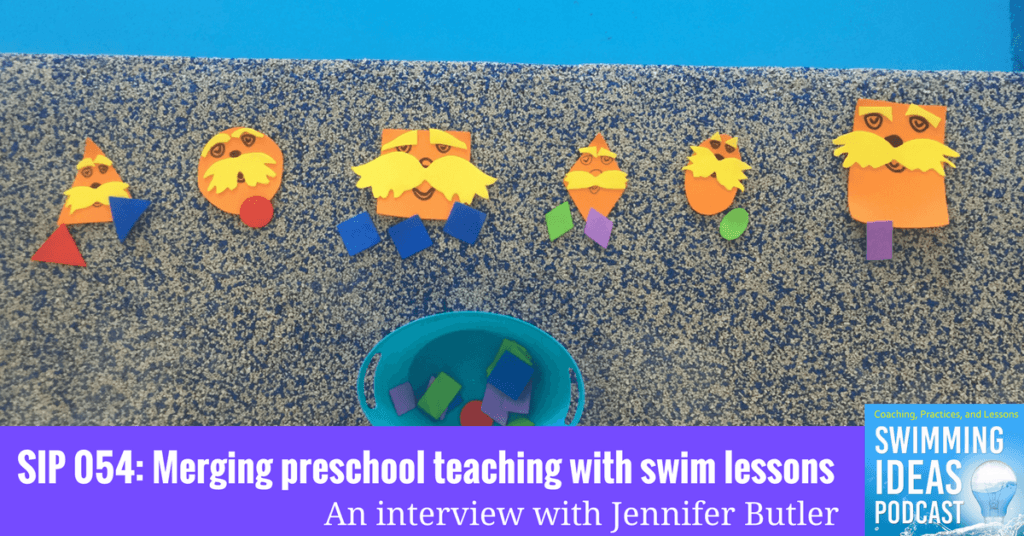
Lorax Shapes and Truffula Trees
Maybe thishttp://amzn.to/2nACUkz
Turtle Eggs and the Belly Bar


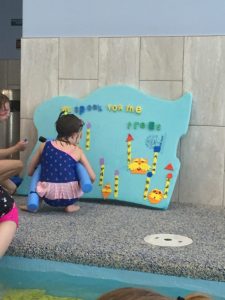
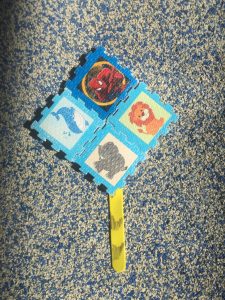
When using the Turtle eggs, Jenn talks about the “belly bar.” I thought this was a great integration of the platform/dock that they use in the water. When swimmers travel over it, they have to lay on their belly on the bar, and then slide forward (simulating a dive in a minor form) and then continue in their travel.
Brilliant Book Games
@ 1:00:00 Jenn goes into detail about some games that they play with books for their beginning level classes. She describes how she integrates images and concepts from popular children’s books and does activities with them in the water.
Learning to Listen to the Child
Jenn tells a story where she tells a kid that was crying, “You can tell me when you need help.” And the kid immediately stopped freaking out and said, “Really?” And then he just started gushing and talking to her expressing his feelings, fears, and apprehensions. The lesson that you can pick up a kid and take them somewhere because you know they’ll be fine isn’t always the best approach for everyone is a good one to learn. Jenn became aware in the moment that her singular approach or typical approach wasn’t entirely appropriate in that one specific instance. She adapted to the child she was working with. She paid attention to the specific child’s needs and responded to him in a way that created a connection of trust.
“Kids want to tell you something, but they don’t know how to say it.” We are swim instructors that need to listen to our participants and be open to their concerns and fears.
You’ll hear that we echo the same passion for reading children but not offering yes or no questions to scared swimmers. Instead, we train our staff to ask open-ended questions that do not supply a fear, hesitation, or excuse. “Can you tell me why you’re crying,” instead of, “Are you crying because you want your mommy?”
Open ended questions:
“How do you feel?”
“What do you want to say?”
As an instructor, avoid asking the ‘yes’ or ‘no’ questions and ask open-ended ones.
Hiring and Training
@53:00
Jenn employs the “shadowing” or apprenticeship mode of training where new hires will get in the water with a veteran instruction and learn how to teach in the classes. After about 40 hours of training, they gradually move into doing single skills under the guidance of the veteran instructor. Jenn is a strong believer in doing and attempting to learn versus only book learning or being told. Through apprenticeship, she’ll give new instructors mentorship and guidance through trial and error and apprenticeship learning.
I talk about “shadowing” in two previous podcasts:
You’ll be able to tell, but we both believe and practice apprenticeship and shadowing in our training. I also recommend you do the intense classroom instruction using either a workbook or an online course to teach swimming specific concepts and language before or during your apprenticeship training. Give your staff supplemental material that they can reference on their own at home or during scheduled review and training. It can serve as a reference for future ideas, and it can be a guide for standard practices in your program.
Learning from Staff
@57:00
One of my favorite moments of this conversation is where Jenn talks about stopping and watching her staff teach swimming lessons. She goes into detail where she sees one of her instructors teaching in a way different from what she generally trains her staff to do. But she waits and watches, she looks at them and asks herself, “why are you doing it this way?”
One of my favorite moments of this conversation is where Jenn talks about stopping and watching her staff teach swimming lessons. She goes into detail where she sees one of her instructors teaching in a way different from what she generally trains her staff to do. But she waits and watches, she looks at them and asks herself, “why are you doing it this way?” And then sometimes she learns something new and useful.
Do you want to share your story?
Connect with me via emailjeff@swimmingideas.comor connect on twitter:@swimmingideas
We want to hear your story and learn from your swim program. Take a moment to reach out and get an opportunity to be featured in one of our podcast episodes. We all have great solutions to teaching swimming and can benefit from your experience.a href="https://goo.gl/forms/P5rEoLOuLsi221vF2">

Thank you to Jennifer Butler and Roots Aquatics:
Check out Jenn and her swim program atwww.rootsaquatics.com
She said she would love to share her ideas and you can contact her atjennb@rootsaquatics.com