
Do you want to electrify your swimming lessons? See the spark of pure joy blossom in your swimmer's eyes?
We can capture lightning in a bottle. We can reproduce delightful laughter and thrilling accomplishment.
We have two "super powers" in our toolbox.
And you can use them in your lessons right now! There is nothing holding you back from supercharging your swimming instruction but your own hesitation.
1. Activity, Activity, Challenge Formula
We've covered this extensivelyelsewhere, but the essential point of this formula is that you do a basic skill, iterate on it with the next skill, and then play a challenge or game to reset your learner's interest.
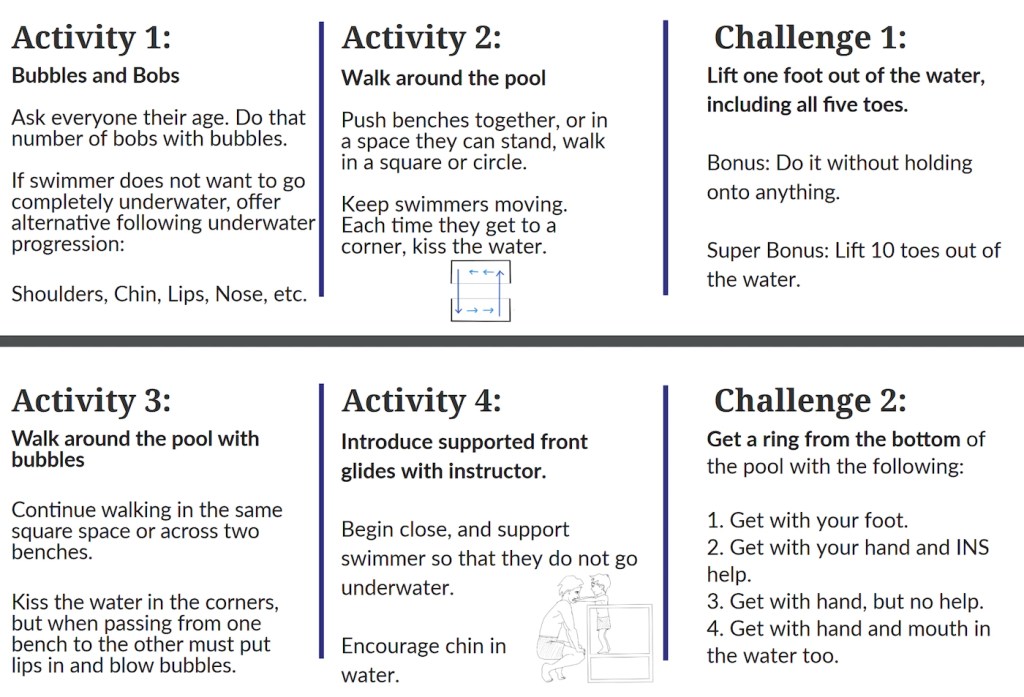
Check out the top row in the picture above. You see that this is for Level 1, where we begin with the initial skill: bubbles and bobs. The swimmer gets accustomed to being in the water, does something fun, and the instructor has clear instructions on what to do.
Moving from left to right into Activity Number 2, we see that the class will use benches and begin moving through the water. Swimmers should do this independently, with the instructor on the outside of the benches guiding the activity. This is the beginning introduction to free motion and play — one of the essential swim skills.
Finally, continuing with that top row, we get to Challenge Number 1. This is a simple challenge for someone who can do it, but it leans on many different swimming skills that can be taught or introduced at this time. The challenge is:
h5>Lift one foot out of the water, including all five toes./h5>
It is super simple but requires the beginner swimmer to do something outside their comfort zone. It is not immediately apparent that they will be able to do it, and most children will struggle to lift one foot above the water if they are standing in chest-deep water.
Why This Formula Is So Effective
It takes simple progressive skills that are connected to each other in Activity 1 and Activity 2 and provides an opportunity for the swimmer to focus on deliberate practice. We push our swimmers to do things they may not be comfortable doing. We attempt to make it fun and interesting, but sometimes it is simply repetition and drill work. Drills and repetition can be fun, but they may not be inherently fun.
Challenges are specifically designed to be fun. More than fun, they have a specific swimming skill with an attached roadblock. They are designed to elicit excitement and a sense of accomplishment.
We have a period of dedicated practice or skill work followed by a reset. The reset for attention and interest comes from the challenge. We find that the more we introduce challenges that are fun and interesting, the more energy participants have to focus on their specific swimming skills scattered in between.
2. Challenges
Challenges are different from games.
A game can be an effective tool inswimming lessonsbut does not necessarily contain an attached or specific swimming skill. Games can be joyful and fun, like "Bake a Cake." But games are generally more complicated and require a group of swimmers to all be at the exact same skill level.
Challenges, however, are often broadly available to all abilities within a specific range. For example, you can do a challenge that works for Level 1 and Level 2 swimmers but may not be appropriate for a Level 3 or Level 4 person because it would be too easy.
The best thing about a challenge is that they produce the best moments of pure joy and accomplishment.

If you are using them at the correct level or skill, then it is just beyond the swimmer's comfort zone.
Following the challenges that are in ourlesson planswill give your swimmers abounding excitement and unbridled joy when they finally accomplish the challenge's goal or get a success.
Example: The "Lift One Foot" Challenge
Let's take a look at that initial challenge again. Lifting one foot above the water with all five toes. It seems pretty simple. A swimmer could hold on to a bench and lift their foot up in the air. Simple enough. But put another roadblock in front of the swimmer: request that they can only use one hand to provide support. If that is too easy still, you can say that they cannot hold anything and must lift their foot above the surface of the water without touching anything else. Finally, to make it super challenging, you could require that the swimmer float on their back and lift one foot up in the air.
From this one simple challenge, we can put a series of roadblocks in front of accomplishment. As the swimmer struggles to overcome them, they will experience a wide range of skills and related understanding when it comes to being in the water: buoyancy, center of balance, floating, and support.
Conclusion
Challenges are the superpower to our lesson plans. The formula is like the secret serum that turns a boring swim lesson or swim practice into a lesson full of laughter, joy, and excitement filled with anticipation.
Podcast episode on the Activity, Activity, Challenge formula:
h1 class="wp-block-heading">Which challenges in the free lesson preview have you tried?/h1>
Discussion0 comments