
Understanding the Core Principles
The power in the breaststroke comes from maintaining rhythm, especially the rhythm established by the front body line. Mastering this stroke requires attention to detail in every phase—from the initial sweep to the final hip slam. Here is a breakdown of the mechanics to help you improve your distance per stroke.
The breaststroke is a powerful, short-axis stroke that relies heavily on rhythm and core engagement. Mastering this stroke requires attention to detail in every phase—from the initial sweep to the final hip slam. Here is a breakdown of the mechanics to help you improve your distance per stroke.
Understanding the Core Principles
The power in the breaststroke comes from maintaining rhythm, especially the rhythm established by the front body line. Before focusing on speed, we must first establish and maintain <b>The Line</b> by keeping our spine as long as possible. We then manipulate posture, line, and balance slightly above and below this ideal line, flexing the extended spine.
⚠️ <strong>Coaching Caution:</strong> Extreme care must be taken to ensure that all manipulation is happening <em>forward</em> and never up and down. Up and down movement occurs when the shoulders and head are brought up and back, followed by diving down below the surface of the water toward the bottom of the pool. Instead, we want to focus on manipulating our buoyancy by:
- Loading: Pressing the lungs down below the line.Setting Anchors: Re-directing the lungs forward above the line.Sliding: Moving the hips forward into the position previously occupied by the lungs.
The Arm Mechanics (The Pull)
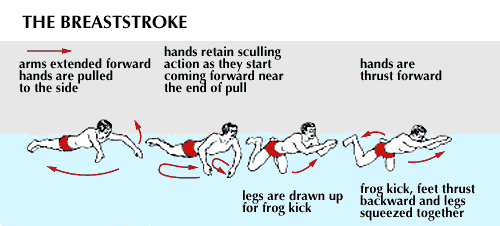
The arm action is a continuous, powerful movement that drives the body forward. Focus on these three phases:
Sweep Out
- Start from The Line (using the same line as freestyle).Sweep out softly (aim for a moderate pace, like 25 MPH) until you reach a wide 'Y' shape known as the Corners.
Inward Sweep
- Turn palms slightly down and back.Begin the powerful Inward Sweep (aim for a strong pace, like 65 MPH) toward the chin.<strong>Key Tip:</strong> Do not drop the elbows; keep them aligned with the surface of the water throughout this phase.
Recovery/Shoot
- Quickly shoot forward back to The Line (aim for maximum speed, like 100 MPH).Keep the arms out in front of the body as much as possible to maintain balance and streamline the entry.
The Body Mechanics (The Drive)
Loading and Anchoring
As you Sweep Out to the Corners, you must <strong>Load</strong>, or press the face and chest forward and slightly down into the water. In this position, about 1 inch of water should run over your back. This action creates hydrodynamic resistance that 'wants' to throw you forward and straight up.
To ensure you move forward at an angle instead of just vertically, you must <strong>Set Anchors</strong> at the Corners. During the Inward Sweep, look 45 degrees ahead, and then try to <strong>Slam Hips</strong> forward to where your lungs are in the water. This action brings the hip bone into the ribs for the powerful 'Strike' position. This is the single most critical element for maximizing distance per stroke.
Breathing Technique
A common mistake that severely limits performance is lifting the head during the Sweep Out for a breath. This eliminates your ability to Load properly and causes the swimmer to land on their chin instead of on their forehead, disrupting the line.
- The swimmer should extend the neck during the Inward Sweep (similar to the breathing motion in Butterfly).Crucially, never move the head to initiate the breath; allow the body's momentum to guide the neck extension.
Final Considerations
Remember that the <strong>Hip Slam</strong> will determine the angle at which your arms can Recover. Do not try to force or recover the arms above the water on purpose; let the power of the hips dictate the arm recovery path.
Discussion0 comments