
Finally. I’m done with swim team for this week. I coach two developmental swim groups back to back Monday through Thursday. We have 86 kids this fall in those two groups. It is nuts. How do you handle large groups of kids that don’t know what they’re doing?
I like to prepare in advance and lean back on those systems and structures I’ve built up over time and test them out. In a funny coincidence, we had a challenge at a staff meeting on Wednesday where we had to create a bridge out of popsicle sticks that met two goals:
- Be longer than any other team.Support the weight of an egg for 1 minute.
I came up with this design and me and my team assembled it. We won! Our bridge was 36’ long.
We wanted the bridge to sag, to bend, and to dip under the weight of the egg. That is how we got it that long. I’m going to use this bridge as a metaphor for how we’ve run our swim practices with 50 new swimmers out of the 86 in a tiny 4 lane 20 yard pool.
The bridge we made succeeded because we let it flex with the weight of the egg. It dipped down. It could do this because we anchored it in place with some strong support. You can see it go through the chair and the cross bar taped to the long two tracks.
When you prepare in advance for a swim season, it is like you’ve built the anchors and the supports on the edges of your program. Create swim lesson plans, create an outline of what skills you want to work on each week and it is like you have a stable foundation to move forward with.
If you follow a set structure like the one we use with our developmental intro swim team group, then when you have 50 new swimmers that have no idea what a streamline is, you can flex like the bridge and still be held aloft by your foundational anchors.
The Foundational Framework for Developmental Swim Groups
I sent this out in an email to all my new participants. It outlines the general format of our intro developmental practices:
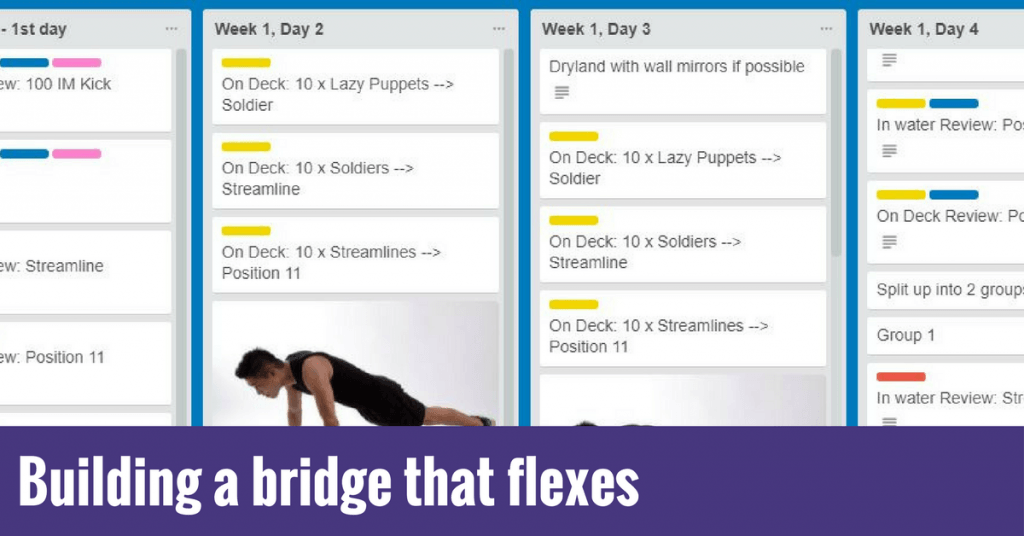
Warmup:100 IM Kick2 x 25 position 11Short team activity, usually 50 kick or swim Small group activity #1We will split up into 2-4 groups and rotate through each station. This is where we teach and drill new skills. Team activityUsually a 50 kick or swim, or a 100 kick or swim. Generally, this is an opportunity to practice during a longer distance what we just worked on in the small groups. Game / Small group activity #2Depending on the complexity or the duration of the first small group work, we’ll work on a second skill, or a more complicated version of the previous skill. Sometimes we’ll play a game or do a contest based on the theme of the day.
That is the general structure of every swim practice for our first developmental group. Right now I have 44 kids ranging from 6-13 in that group. They are all able to minimally do 1 length of freestyle with side breathing, 1 length of backstroke. Some know breaststroke kick and butterfly kick. They’re together because they don’t know the framework yet, and they’don’t know the basics like circle swimming, streamline, and how to “set up a lane.”
Skill Progression Goals: What Developmental Swimmers Should Learn
Here is the outline I provide to parents for that first group on what their swimmers will learn:
In the next group, we start teaching how to swim breaststroke and butterfly. If you want to see swim team practices for Developmental 2 groups, check out the Complete Swimming Program. With an active subscription you get access to 11 weeks (4 days a week) of swim practices on Trello.com. These practices walk you through every activity we did from the Spring through the Summer and how we got participants swimming every competitive stroke legally.
The Power of Systems: Why Preparation Matters
The framework I’ve outlined here and the practices in the Trello boards are great. They’re the tools I rely on to train my assistants and introduce new swimmers to the sport. I fall back on these systems because they’re effective. The key is that I’m willing to look at my coaching and the activities I do and evaluate their results. I make notes, and reexamine why we did a particular activity. Check out my posts on the “fail box”" and how it evolved over the course of three weeks. You’ll see an activity grow and change over time into the successful powerful game/activity it is now.
Remember though, new swimmers are challenging. This week wasn’t all roses. In fact, it was quite difficult.
While there were times that I lost my patience with these new swimmers, and with the returning kids too that were acting rowdy, I took a moment to sit back, take a few breaths, and slide back into my preparation.
I referred to my materials that I created in advance and used them to highlight my points. This ability to pause and rely on tested structure is what keeps the lesson plan flowing, even when the energy in the pool is chaotic.
Ready to Implement: Accessing Our Protocols
The first week of the Intro Developmental Swim group practices are live on the Trello board. Want to see exactly what we do at practice? Want to see our tested, reliable formula in action for new swimmer success?
Want to see the very thing I hand (on an iPad) to new assistant coaches?
Check out the Complete Swimming Program and get access today.
Discussion0 comments