
Beyond the safety of swimmers, the absolutely most crucial aspect of teaching swimming is the instructor's ability to give feedback. Feedback is using your words to identify actions and provide an alternative or improved action for future attempts.
That was a dense sentence. Let's break it down:
- Feedback = words that create better actions.
- Feedback = pointed language that improves swimming.
- Feedback = watching a swimmer, identifying what can be fixed, and telling the swimmer how to fix it.
There are so many ways to give feedback, and the worst thing I see instructors doing is… NOTHING! So often, newer instructors tell swimmers what to do — "three streamlines" or "two 25s of freestyle with side breathing" — and then they stand there and watch, maybe saying something like "good job."
That is nothing! Nothing! I want to pull my hair and scream and throw myself in front of watching parents so they don't see the total neglect of their swimmer when the instructor gives no feedback!
When you see a swim instructor giving feedback that creates a new action and improvement, you can see the excitement blossom in the swimmer, the parents, and your program.
Scroll to see more!

Feedback has three parts.
- Observe the swimmer's behavior or attempt
- Identify the things that can be improved
- Give actionable instructions using verbal, non-verbal demonstration, and guidance to do the improved action on the next attempt
To give feedback, follow this formula: [you did this], "next time," [do alternate action on next attempt].
Observe the swimmer's behavior or attempt
Swimming lessons are a chain of activities, games, and challenges designed with an instructive purpose. We want to get people to learn the four competitive strokes and related safety skills like treading water and getting safely to the side. Part of your role is to tell swimmers what activities and games to do and in what order. Swimming Ideas provides lesson plans, online courses, and practices that you can use to do that well.
But that's one part of the lesson. The next, most critical step, is giving high-quality feedback that creates better swimmers.
Tell the swimmers what to do, then begin with the first of three steps in giving feedback:
See the swimmer swimming.
Watch the swimmer do something. Pay attention to their actions and what they're doing.
Identify things that can be improved
As you observe and watch the swimmer do something, think about what they are doing and how it relates to your goals. Does the arm motion match what is expected? Does the body position look controlled and in line with standards? What is the head doing? When did they breathe? Did they do the three things to streamline?
Look with a critical eye that pays attention to actions, movement, and behavior, and then catalogue what needs to be improved.
See what can be fixed. Choose items that can be changed.
Give actionable instructions with words and demonstration to produce an improved next attempt
Use your words to create better future actions. Demonstrate and provide guidance through media like video, pictures, lesson plans, or references to illustrate your points.
Silence and empty praise are useless.
In some cases, they may even be detrimental to the swimmer’s progress.
When a swimmer does an action, the swim instructor watches them, and then says or does nothing.

No smile. No response. No emotion.
Nothing.
When you say something as worthless and meaningless as “good job,” “great,” “good.”
*These are comments made without context, attention to detail, or connected to a previous conversation.
** Often these are comments that clearly convey that the instructor did not even see the attempt, or doesn’t know what to make a comment on so they give empty praise.

Unrelated comments or statements that are no connected to the swimmer’s attempt.
Worthless words. “Good vibes, man.”
Give feedback that changes lives.
When you watch a swimmer do something, you know what they should be doing, are aware of the mechanics of the movement, and know how they should instead do it, you have an opportunity togive feedback to improve that swimmer’s skill.
You can change their life by using your words.
Speaking with highly specific attention to what the swimmer did and what they can do in the future to change is transformative.
The language you use should be targeted to what a swimmer can physically do appropriate to their age, ability, understanding, and comprehension.
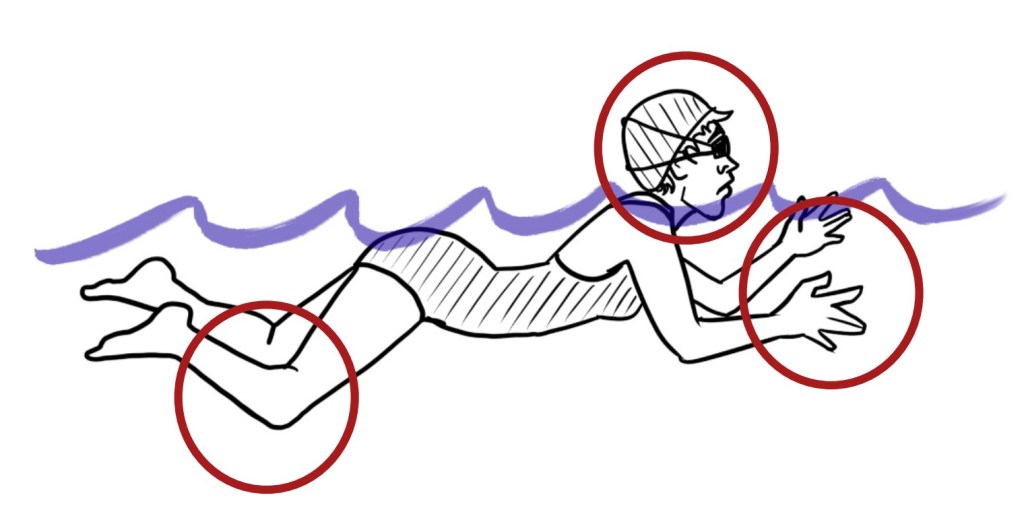
How do you get from poor swimming to good swimming?
In this case I would suggest the following fixes:
- Aim face at the bottom of the pool and drag your Pinocchio nose along the black line.
- Let your toes be floppy and straighten your legs without bending your knees too much
- Many small kicks instead of fewer strong/aggressive kicks
- Reach to position 11 (and demonstrate position 11) with every arm stroke
- Avoid lifting your head to breathe and instead rotate your face so cheek is in the water when taking a breath.
When in doubt, watch the swimmer and SAY something to help them improve or acknowledge their effort to the given task.
I believe in you. You can do it.
Start giving transformative feedback today!
You can use our Teaching Swimming online course, workbook, and lesson plans to give AWESOME FEEDBACK that will change lives, improve swimmer skill, and make your lessons Fun and Effective.
Individuals
A single person can access online courses, documents, and a files.
div class="wp-block-buttons is-layout-flex wp-block-buttons-is-layout-flex">div class="wp-block-button has-custom-width wp-block-button__width-100">$99.97 / yeardiv class="wp-block-column is-layout-flow wp-block-column-is-layout-flow">div class="wp-block-image">figure class="aligncenter size-large">a href="https://www.swimminglessonsideas.com/membership-all-access-for-teams-agencies-and-groups/">
Agencies & Teams
Every staff member can access online courses, documents, and files
div class="wp-block-buttons is-layout-flex wp-block-buttons-is-layout-flex">div class="wp-block-button has-custom-width wp-block-button__width-100">$997.97 / year
Discussion0 comments