
It may be obvious that LLMs (large language models) are all the rage and making things better for everyone. I've been fascinated with these tools for a few years now. While I find them useful for creating things like thePremium Lesson Plan Builder(which took many more hours than a simple prompt) and theSwimWriter Protools, I'm also curious how to make these tools work for us as Aquatic Professionals.
For example, you can load all of your year's Daily Logs when you export them throughaquaticpro.organd put the JSON or PDFs into NotebookLM. Then, you can ask the LLM to review all the daily logs and identify trends, struggles, find solutions, or see who was the most prolific writer. It is a tool that uses your personal repository of data instead of being a general-purpose question-and-answer device.
Now you can make custom responses and items directly related to your personal or work data.
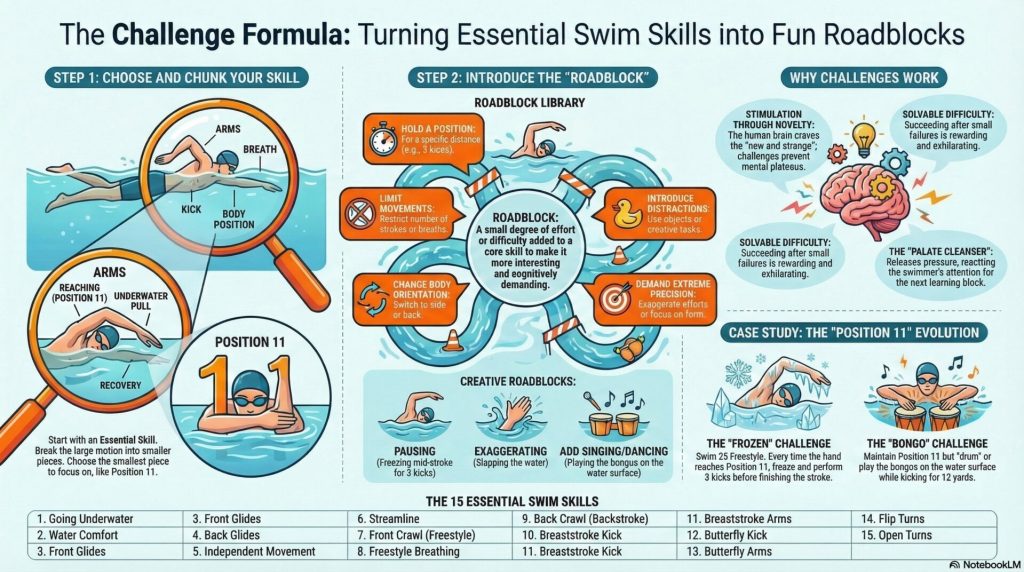
I have many of Swimming Ideas' lesson plans, guidance, levels, and games loaded into NotebookLM. Here are 2 infographics on how to create new and effective swim games. They're useful, but not perfect. But useful enough to share with all of you.
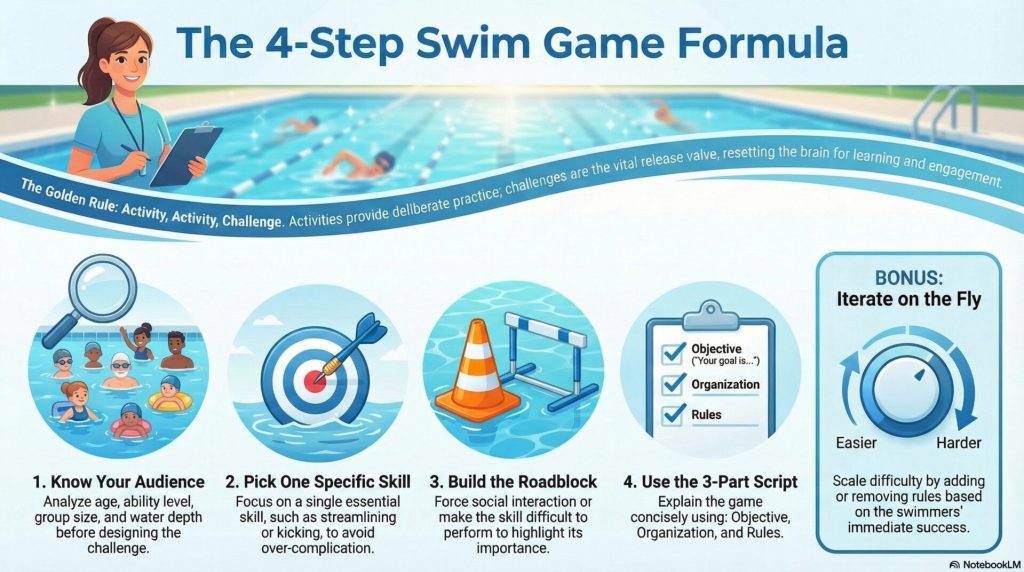
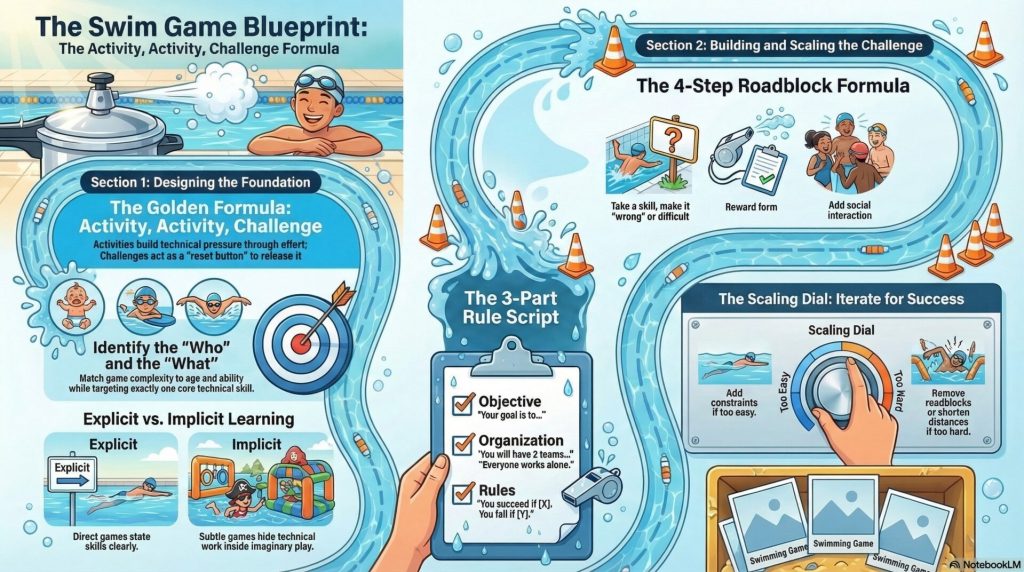
There are some spelling errors, some weird choices, but the CONTENT is accurate. The content and the details are true because they're based off of my own already documented posts and information!
Here are some examples of what I have in my NotebookLM repository (files stored so that the online tool can use this as its guide).
A challenge can be simple.
A challenge can be FUN.
Connect challenges to an essential swim skill.
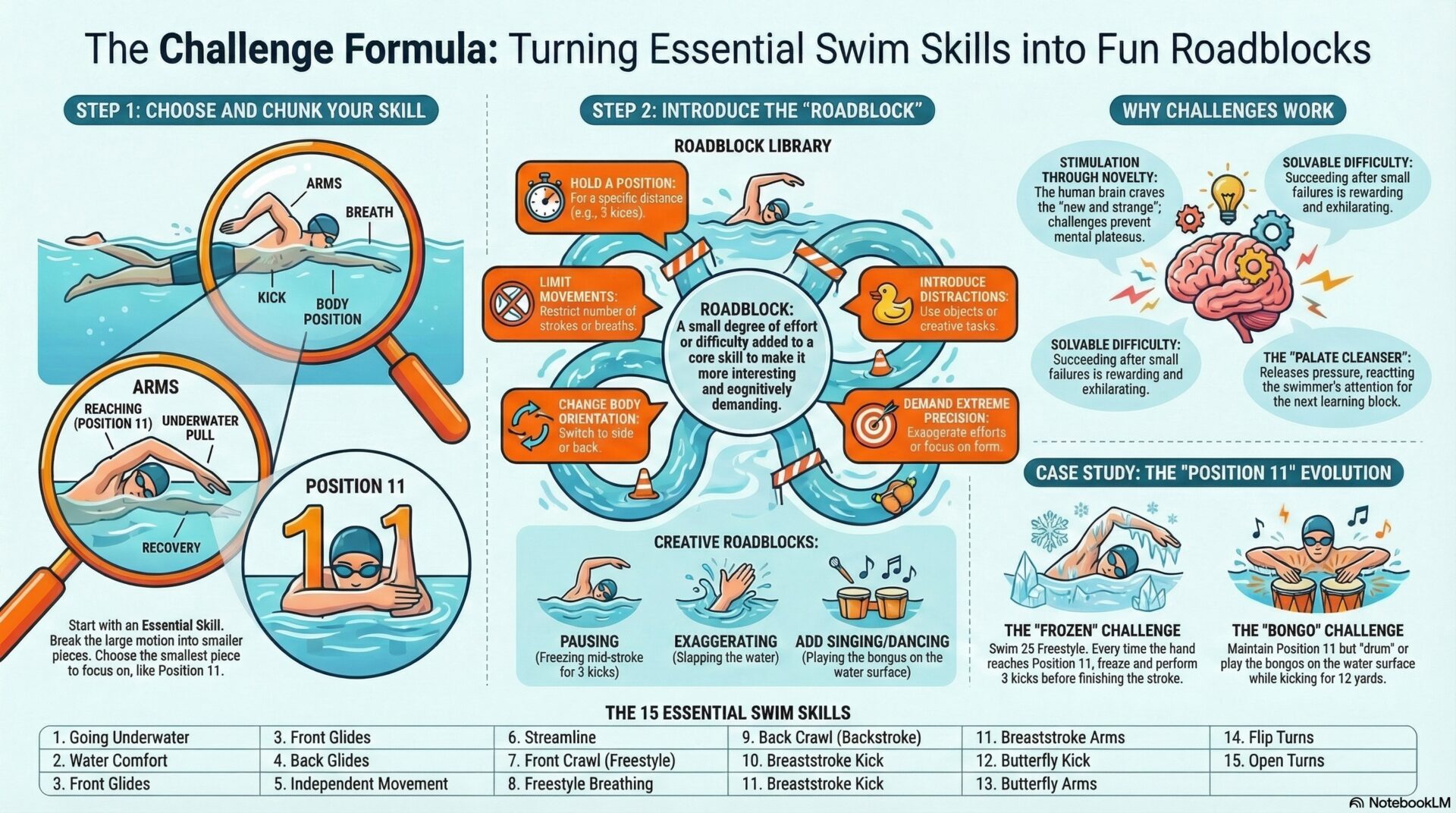
Step 1: Think of an essential swim skill.
We have 15 essential swim skills. They are listed in the first section of the Teaching Swimming online course.
Here are a list of a few.
- Going underwater
- Front glides
- Back glides
- Water comfort
- Independent movement
- Body control
- Front crawl
- Back crawl
- Breaststroke
- Butterfly
- Flip turns
- Open turns
**IMPORTANT NOTE!
Begin your swim skill choice with one of the essential skills, and then “chunk” it into smaller pieces and focus on a smaller piece. It is okay to get really granular, or small, when you’re trying to invent a swimming challenge.
The above flow is how I would think about a core skill. I’m taking the first large motion: FREESTYLE or Front Crawl and “chunking” it into smaller pieces:
- Breath
- Kick
- Body position
Then, I choose, “Arms.”
Then I chunk that out into smaller pieces:
- Reaching intoPosition 11
- Underwater pull
- Recovery over the water
I choose, “Position 11.”
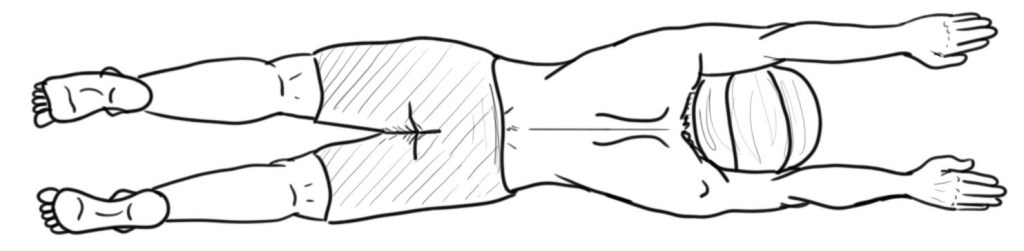
Now I know what skill I want to focus on. I begin thinking about Position 11. What is position 11?
Step 2: Put a roadblock in front of your essential skill
Another example from the example list.
Let’s look at the last line:
“Add singing or dancing; play the bongos in position 11 for 12 yards; can’t bend elbows.”
After thinking about the first example challenge of freezing in position 11 for 3 kicks I kept thinking about roadblocks to doing position 11 or adding things to make a boring old position 11 kick more interesting.
What do people do when they’re bored without phones? They sing, hum, fidget, play the drums with their fingers! AHAH!
Add singing or dancing.
That lead to the challenge:
3 x SL + Position 11 with kick to 1/2 way. After your streamline, keep your arms in position 11 but drum or play the bongos on the surface. The swimmer with the best “Beat” after 3 attempts wins and gets to choose how to swim the next 2 x 50’s.
Tangent: Why are roadblocks fun?
- Doing the same skills DIFFERENTLY is interesting
- Facing a small, solvable, achievable DIFFICULTY is rewarding
- Succeeding after multiple FAILURES is thrilling/exciting/exhillariating
Challenges are not meant to be impossible. They’re meant to have some degree of thought and effort in them to experience success.
Something Different:
Our brains crave stimulation through the novel, new, and strange. We stop and stare at the bizzar.
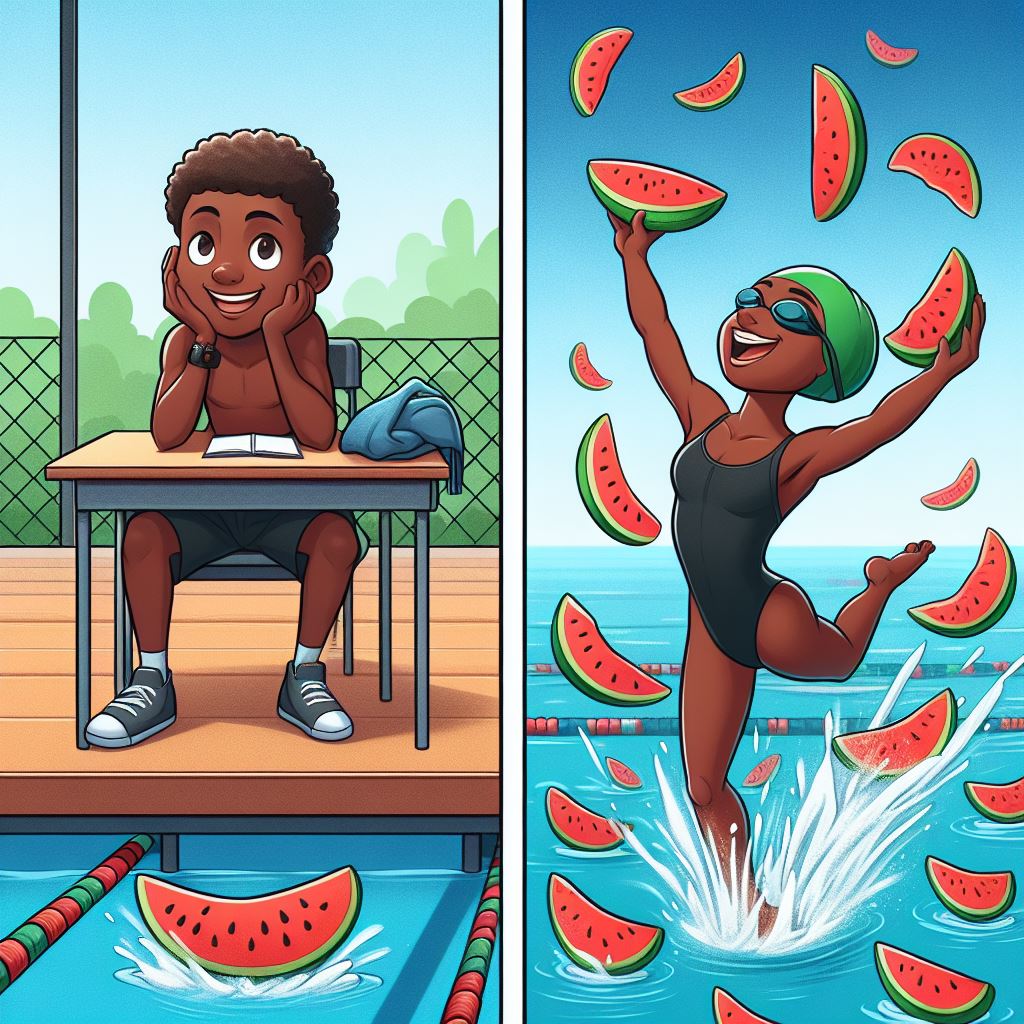
Beyond the wonky AI weirdness of the pictures, how much fun would a challenge be where you have to swim a 25 of freestyle, avoid a bunch of cut up watermelons, then at the end spit out the seeds to hit a target, and have it all timed as a race?
Totally ridiculous, but its INTERESTING.
Challenges should be similar, but do not need to be strange, incomprehensible, or impossible. Challenges need only be slightly different, and need only provide a small difficulty or roadblock to make it memorable, interesting, and fun.
Presented with difficulty we want to overcome it.
Why do people climb mountains? Why do they solve the unsolveable problems? Why do we look at something and ask ourselves: that’s not easy. Can I do that?
We love overcoming a challenge. We love solving problems and if we create a culture of excitement, respect, and the role of a TEACHER, we give small, achievable problems for our swimmers (students) to solve.
The challenges in the Daily Lesson Plans are breadcrumbs, trails of small achievable “wins” that leave a path of simply difficulties leading up to more and more thoughtful problems that swimmers need to solve to earn a success in a challenge.
At first, the challenges are fairly simple and require physical movement. They grow and change to include more thoughtful effort.
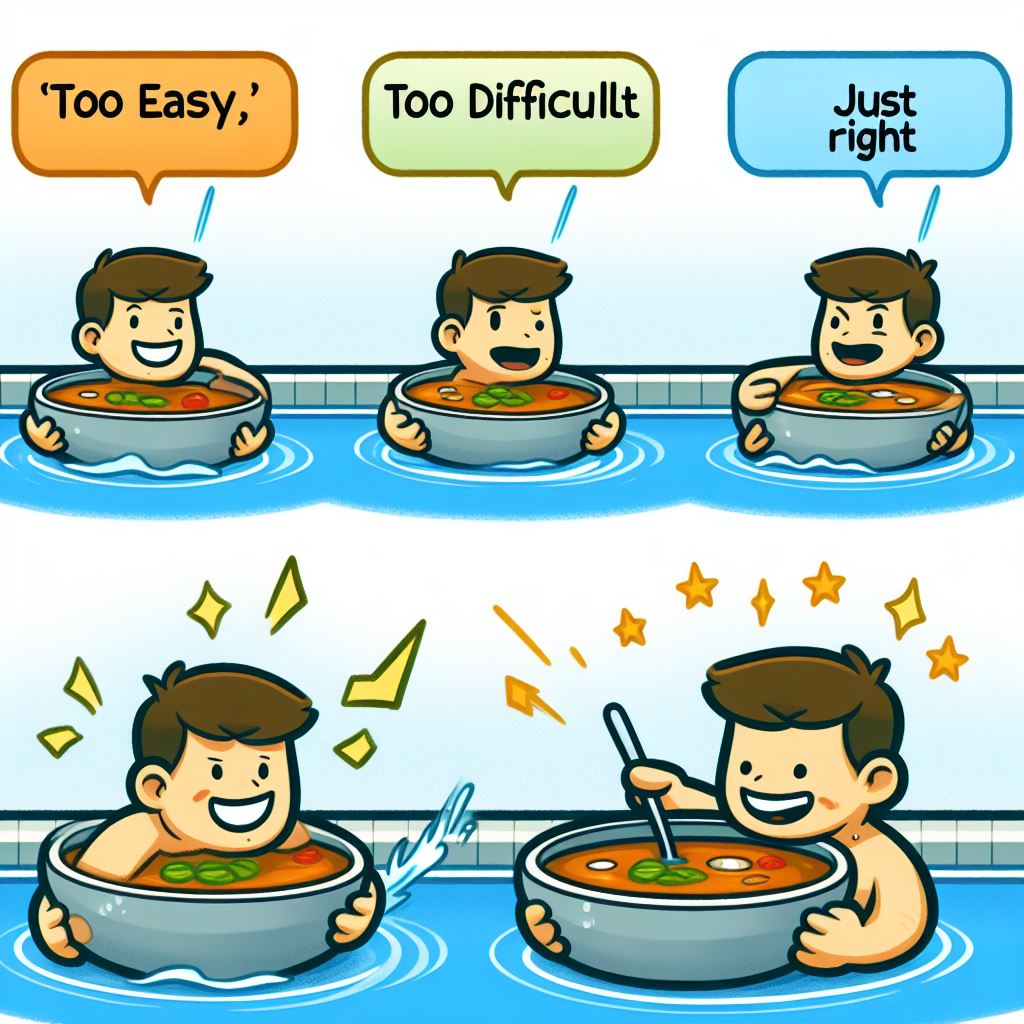
When you’re creating challenges, think about your participant and WHY the challenge is fun. Its fun when its not TOO easy, but also not TOO hard.
We want our swimmers to earn as success.
Succeeding after failure is bliss.
80% of your swimmers should be able to do your new challenge. Maybe not right away. Maybe not on the first attempt. But after some thought, some practice, some effort, most should be able to achieve a success to your challenge.
And that’s WONDERFUL!. The dopamine and the bliss, the joy, and the smile of excitement that you see after an eventual success should thrill you too.
Challenges should be achievable.
- Not too easy
- Not too hard
- A small amount of difficulty so that success feels earned.
Step 3: Evaluate your Challenge
You’ve thought of your essential swim skill. You chunked it into pieces. You brainstormed a few roadblocks, chose one, and crafted a challenge.
Your work is not done.
It’s time to evaluate whether your challenge will survive first contact or should be discarded like splashed water on a pool deck.
Ask the following questions during your swimmer’s attempts or after:
- Is the challenge achieveable? Did enough people earn a success?
- Was the challenge too simple; everyone succeeded immediately.
- Was the challenge too difficult; everyone failed, over and over and then gave up.
- Did the challenge work on the wrong skill?
- Was the challenge too divorced from your chosen essential swim skill?
Make small adjustments, try again, and if it is a fail:
Start at Step 1!
And here is one final output after refining the info graphic data and prompt a little:
Discussion0 comments