
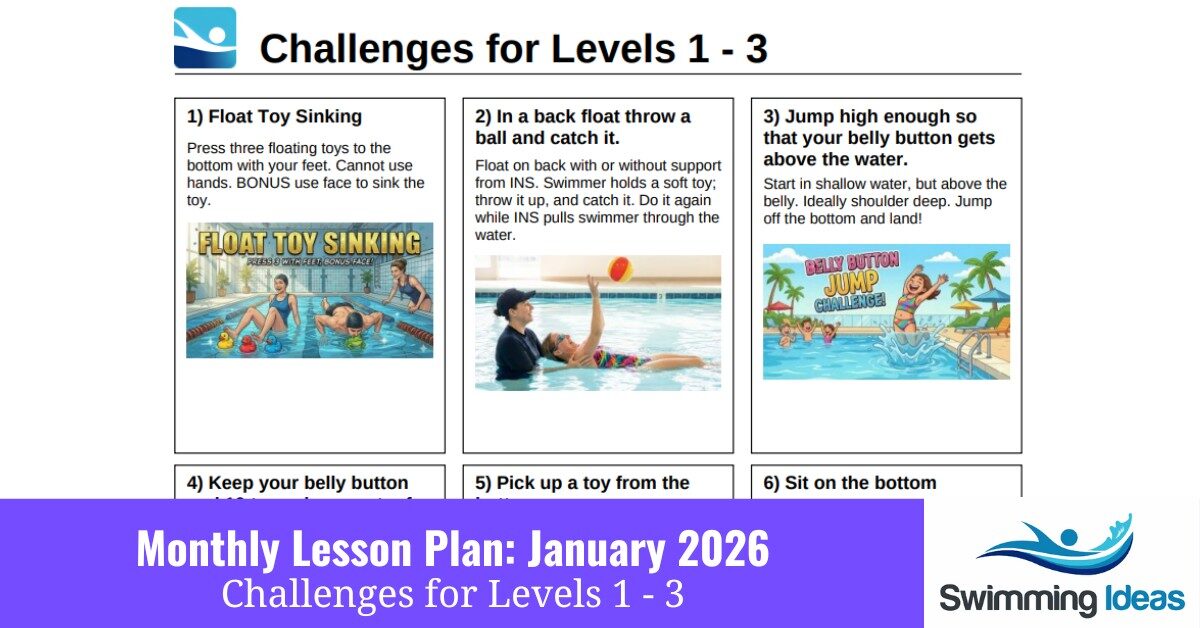
Every year I look at the lessons my program is teaching and ask: "What do we need to improve?"
Almost every year the same thing becomes clear. There is a significant gap between following the lesson plans (or not, as most people set them aside) and doing challenges.
The issue isn't ill intent. The issue is that people forget to do challenges, or they don't think with a creative mind to design a challenge that meets the swimmer where they are.
This month's training and goal is to get people toDO CHALLENGES every 5-7 minutes, or after 2 activities.
Challenges are one pillar of instruction that will dramatically improve the quality of your program.

What is a challenge?
A Challenge is the third and final component of the standard lesson formula. While the first two "Activities" require deliberate practice, intense thought, and effort, the Challenge is designed to be fun, energizing, and a "reset" button for the swimmer.
The Challenge's primary function is to release the pressure that builds up during the focused work of the lesson.
A Challenge serves as a "palate cleanser," providing a quick and entertaining diversion that recharges the brain for future learning while still remaining connected to swimming skills.
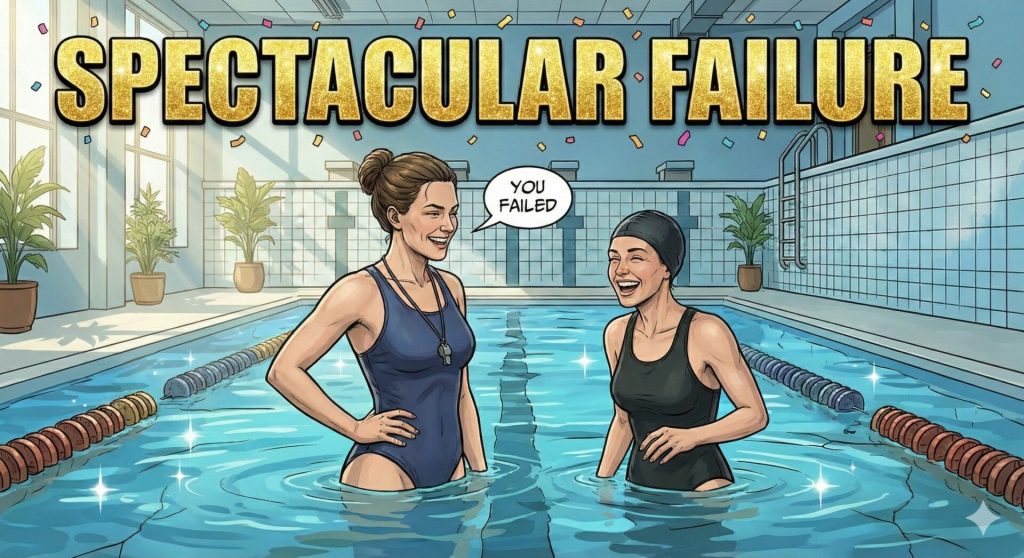
Importantly, challenges allow for and even encourage<span style="text-decoration: underline;">"spectacular failure"</span>, where a swimmer can be told objectively that they failed a task without it being punitive, helping them understand the limits of their ability.
How to Create a Challenge
To create an effective challenge, follow this four-step progression:
Make the Challenge Quick
- Explain it in very simple terms.
- Give swimmers time and opportunity to do it at least 2-3 times.
- Praise the successes and acknowledge the failures with feedback to improve.
Why Every 5-7 Minutes?
Releasing Mental Pressure and Resetting Focus
Instructional activities require "Deliberate Practice," which demands intense thinking and effort from the swimmer. As swimmers focus on specific skills, these activities "build up pressure and steam."
- The challenge acts as a "palate cleanser" for the brain.
- It serves to "release the pressure" built up during the focused activities, allowing the brain to recharge for better learning in the next segment.
- Challenges are designed to be fun and energizing, hitting the "reset" button on the swimmer's attention span.
Preventing Wasted Time and "Lazy" Instruction
Avoid "play time" or games for the final 5 minutes of a lesson.
- Saving games for the end turns a 30-minute lesson into a 25-minute lesson with "5 minutes of nothing" at the end.
- Doing a challenge periodically throughout the lesson ensures the entire duration is used for instruction, rather than using the end of class as a break for the instructor to be "thoughtless, bored, or reset."
Maintaining the Learning Formula
The curriculum is built on the Activity, Activity, Challenge formula. This structure is designed to layer skills and then test them in a fun environment.
By inserting challenges every 5-7 minutes, you keep the lesson dynamic, maintain high energy, and maximize learning time. This approach prevents burnout for both the swimmer and the instructor, making every minute count.
Activity 2: Advanced version of that skill (Deliberate Practice)
By cycling through this formula (which naturally takes about 5–10 minutes per cycle), you ensure that fun and skill acquisition are interwoven, keeping engagement high throughout the entire lesson rather than just at the end.
Here are specific ways to increase the difficulty of a challenge:
•Change One Specific Element:You can modify a single variable to scale the difficulty. For example, in a challenge requiring a swimmer to hold one foot above water, you can change it to holding “only 3 toes of one foot and 2 toes of another foot” above the water.
•Limit Physical Movement:Restrict which body parts the swimmer can use. In the “Spin without touching” challenge, you can make it harder by allowing the swimmer to use only one hand to spin or requiring them to keep their head and neck completely out of the water.
•Increase Intensity or Volume:For the “Bucket Head” game, you can iterate by using a bigger bucket, pouring water directly over the face while the swimmer looks up, or requiring multiple pours before they are allowed to wipe their eyes.
•Adjust Time Constraints:You can shorten the amount of time allowed to complete a task, such as reducing the time allotted to spin around twice.
•Add Conditions to Skills:You can turn basic challenges into games by adding specific conditions, such as requiring a swimmer to “streamline to the flags and breathe on the second stroke off every wall,” and subtracting points if they fail to meet that condition.
When iterating, you should ask yourself, “What limits are put in place to make the skill more difficult?” and adjust the challenge to test that specific boundary.
Challenge PDF Lesson Plan:
Created with the Premium Lesson Plan Builder:
Discussion0 comments