
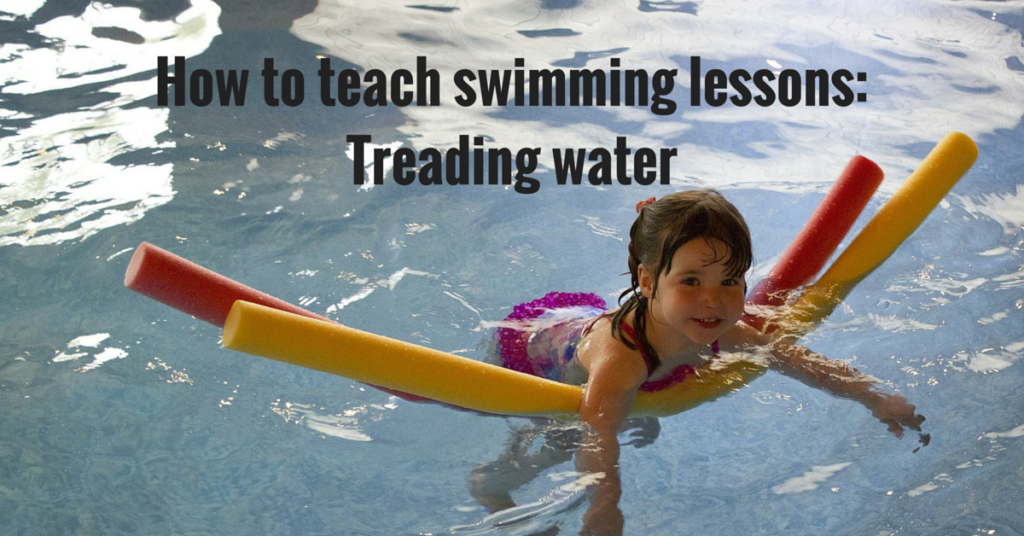
Balance Before Lift: The Core Concept
Teresa will show in her own words how you have to teach balance to the swimmer before you can start teaching them to keep their head up while stationary. I think a true confident swimmer is the person who understands this concept of water balance; the person who can float at the surface barely moving their body to stay at the top using breath and treading. That person can rotate, press, lay down or forward and still stay at or near the surface with barely any effort. The first step to this control is balance. Teresa attacks treading water by starting with body position and control. It is a brilliant and simple activity that gives purpose to the treading motions we typically teach with lackluster results. Now we have a quick, easy solution.
Treading Water Taught by Teresa from Arizona:
"I thought you might be interested in a few methods I use while I’m teaching my 4-5+ year olds how to “TREAD” in the water. My kids have learned to tread a lot faster ever since I started using the methods so other Instructors might find them handy too."
I realized a few years ago that there is more to treading than just teaching a student how to use their arms/legs. They also have to know HOW TO BALANCE IN THE WATER without falling over and each student HAS TO TREAD AT DIFFERENT SPEEDS to keep their head out of the water. (Not everyone treads the same way EVEN THOUGH an Instructor teaches every student the same way….some peoples motions end up being more effective than others.)
The Three-Phase Progression for Treading Water
Phase 1: Noodle Balance (The Foundation)
- Sit on a noodle like you are riding a bike and practice balancing until they can do it without your help.
- Let go of the noodle and make sure they can balance by themselves BEFORE moving on. (This is crucial for building core stability.)
- Teach them HOW to move their hands and HOW to move their feet properly WHILE ON THE NOODLE.
Phase 2: Swing Balance (Increasing Difficulty)
- Sit on a noodle like you are on a swing (this is much harder for balance) and practice until they can do it without your help.
- Let go of the noodle and make sure they can balance by themselves BEFORE moving on.
- Teach them HOW to move their hands and HOW to move their feet properly WHILE ON THE NOODLE.
Phase 3: In-Water Treading (The Goal)
Once the student has mastered balance on the noodle, they are ready to transfer that control into the water. This phase requires constant coaching cues focusing on breath timing and core engagement, not just arm movements.
Here is a video demonstration of the technique in action:
Have you used this technique? Let us know! We love hearing from you about your <a href="https://www.swimminglessonsideas.com/blog/advanced-lessons-lesson-swim-team-bridge/">swimming lesson</a> successes and failures.
Discussion0 comments