
Step #1: Give commands when announcing what activity is next and how to accomplish that activity. Save the imagery and colorful rich feedback for individual corrections.
The second step of Concise Commands
Our first step in giving concise commands is to speak in commands. Give direct sentences with a period at the end designed to get action. Save your illustrations and your images for your individual specific feedback. The second step is to speak concisely, or to give specific short commands that build on previous commands and are targeted to a specific step action.
Organize your commands and instructions using the following formula:
- Announce activity by name: example Streamline with freestyle kick
- How many times will participants do the activity? Example: Everyone will go 3 times.
- How will the participants accomplish the activity? Example:When I call your name, push off underwater. When you get to the surface move over in the lane and get back in line. You can go when the person ahead of you moves out of the way.
- Give success criteria or goals. Example:Remember to do all three things for streamline: look down, lock your thumb, and squeeze your ears. Start underwater and push off in a straight horizontal line.
- Ask for questions
- Give individual instruction on a per person basis for more specific fine tuned instructions to accomplish task. Example:Sally, you need to also make sure you push with two feet off the wall, then lock your thumb, squeeze your ears and look down.
- Repeat critical information throughout.
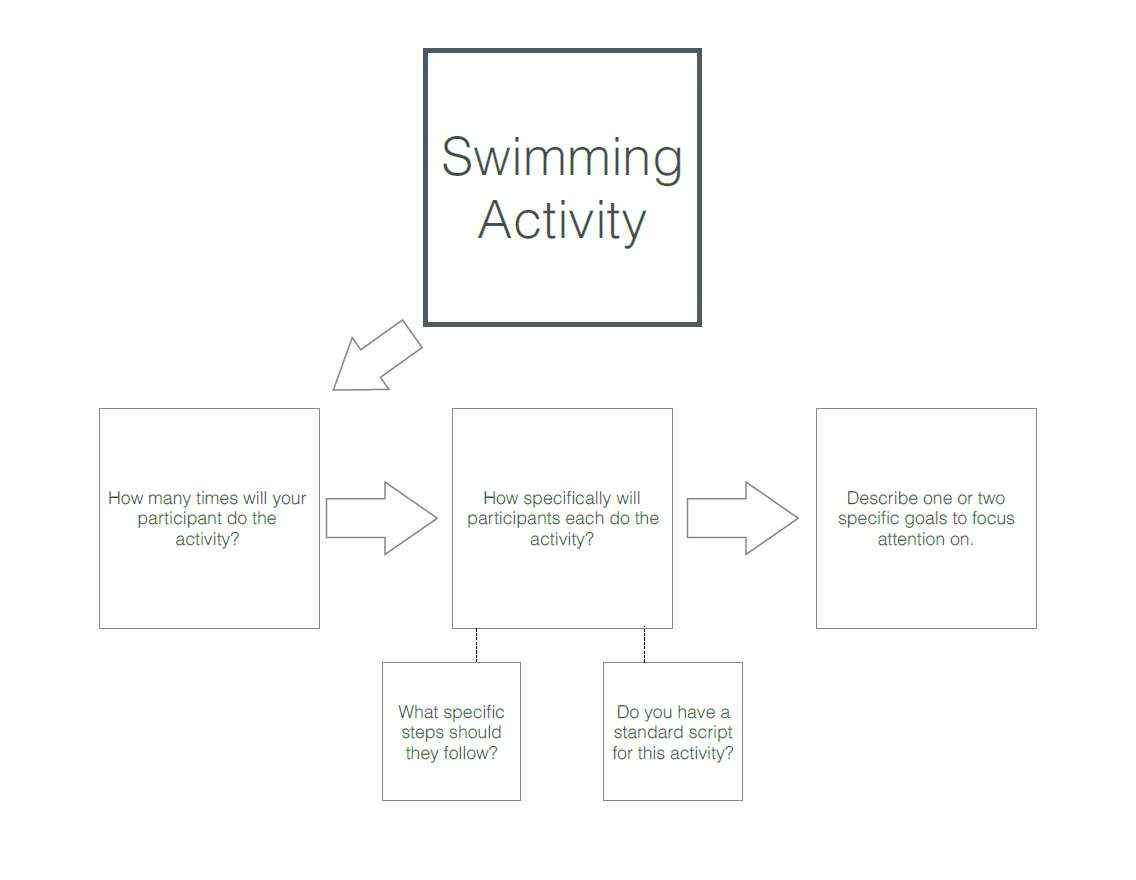
This flow chart is designed to help you move through an activity while providing the best clear commands.
Notice how it starts with the activity itself. Name the activity. Then tell your swimmers how many times that they’re going to do that activity. Usually it will be everyone goes three times. Explain in detail how they will accomplish the activity. Give your specific examples, taking note of what the exact step by step is, and using whatever script you choose to use. Finally, give a focus or a goal for added effort beyond just accomplishing the task generally.
Following this formula will keep your commands and instructions brief, they will remove the temptation to give too many details with too many fine points and distracting tips. Instead, participants will come to expect the formula when they hear your commands. What they’re doing, how many times, what specifically, and what to focus on. When you then repeat the activity, your participants will be able to focus beyond just what they’re doing and be able to spend more energy on fine tuned improvements and goal attainment.
Here are some examples:
Confusing instructions with too many details:
Concise command version of the same activity:
Save the imagery for when you’re giving individual feedback
From the above example of front glides, I showed you to ways to get your participants to do the same thing using different language. The first example is closer to what most beginning swim instructors do: they get lost in the details and give confusing wandering instructions. With the second example we see a formulaic delivery of commands. What are they doing, how many times, with specific instructions and then how it will happen. Once those participants are used to that activity and the general procedure to actually do it, we can add goals and specific focus on top of the activity by itself.
Every time swimmers do an activity we should give feedback if they accomplished the task, or if they need to take steps to improve. We expect that everyone gets some sort of personalized feedback with every attempt. Sometimes it is a thumbs up, or a smile and a head nod. Sometimes it is more specific, “Next time don’t jump up in the air first to get to me, lean forward, start with your face in the water and you’ll make it easier.” The more specific you are the better.
When giving commands, make them as specific as possible and as short as you can. Challenge yourself to give complex directions and feedback using the fewest words possible yet still maintaining the essential meaning,.
Step #2: To be concise, give commands with short sentences using as few words as possible. With every ne activity you do you have a chance to practice getting your point across with as few words and commands as you can.
Instructor Challenges to Improve
Here are a few ideas for things you can do during your new swim instructor training, or during a regular training session to improve your concise commands (for you and for your staff).
Three Activities for Small Groups:
1) Find partners and pair off. One person gives commands to the other partner. Make the commands as brief and quick as possible. Give groups specific things to do and have the partner receiving the commands only do what the speaker explicitly states. For example, have one partner be blindfolded and have the other give them directions to pick something up and drop it off at a different location. Come up with different activities involving giving specific instructions allowing the partner receiving them only doing what was explicitly said.
Some direction ideas:
- Pick up an egg with a spoon while blindfolded.
- Navigate an obstacle course while blindfolded.
- Get in the pool, swim a certain stroke to a location, pick up an object underwater, and exit the pool via stairs. The person doing it can only do exactly what the instruction giver says.
- Start at one location, walk to another, take off shoes, put shoes on and tie the laces, while pretending to not know exactly how to do all of that.
2) Form groups of 2-4 people each. Hand out a piece of paper and a pen/pencil. Leader states that everyone will start at the same location, someplace you’re at, or someplace in a pool area. It can be a place, or a setting. Leader then says, I’m going to write down a goal, or an objective. You need to write down in the shortest sentences you can, and the fewest number of commands to get someone to acheive that goal or objective from the starting position. Write as if you’re telling the person what you are going to do, or what they will do. Be as specific as possible.
Examples:
Setting: Teachign a level 1 swimmer in a private lesson named Billy. You are in the zero-depth (like a beachfront) area of the pool.
Goal: Do 3 jumps in the deep end.
Group examples: Billy, we are going to do a front glide to the deep end together. Put your hands on my shoulders. Let me hold you at the surface. Kick your feet to help us move faster. Ok, turn around. Reach both hands for the wall. Ok, reach, put your lips in the water. 1, 2, 3, go! Climb out. Put your toes on the edge. Do you want to go underwater? No? Okay. Ready, I’m going to help you. 1, 2, 3, go. Ok, turn around. Reach both hands.. (repeat 2 times). Alright, lets do a backfloat this time. I will help you. Put your head on my shoulder, flatten your body, and kick your feet. Keep your hands at your sides. Kick. Ok, sit up on 3. 1, 2, 3. Well done! Great job on your front floats, your jumps and your back floats!
3) Take a sentence and make it short, activity.
This can be done in a large group. Rotate people that come up to the front of the group. Have that person say a rambling or confusing set of instructions. Make them as needlessly complex as possible. When in doubt give too much detail.
The rest of the group should shout out easier, more concise, simpler alternatives to achieve the same goal as the complex instruction.
For example:
Standing in front of group: “You’re going to put one hand on the railing there. Nope, not there, near the water line, but 5 inches above the smallest wave between the 30 and the 31st droplet marks. Then place your right foot on the lower most ladder step, but only use the ball of your feet, letting your toes extend past the step. Then grasp the other railing with your other hand. Pull yourself up and forward.”
Group members:
“Climb out of the pool using the ladder.”
“Use the ladder to exit the water.”
“Climb out here!”
Have you used any of these activities?
How do you encourage concise instruction and language? Leave a comment or connect on facebook or twitter.
Discussion0 comments