
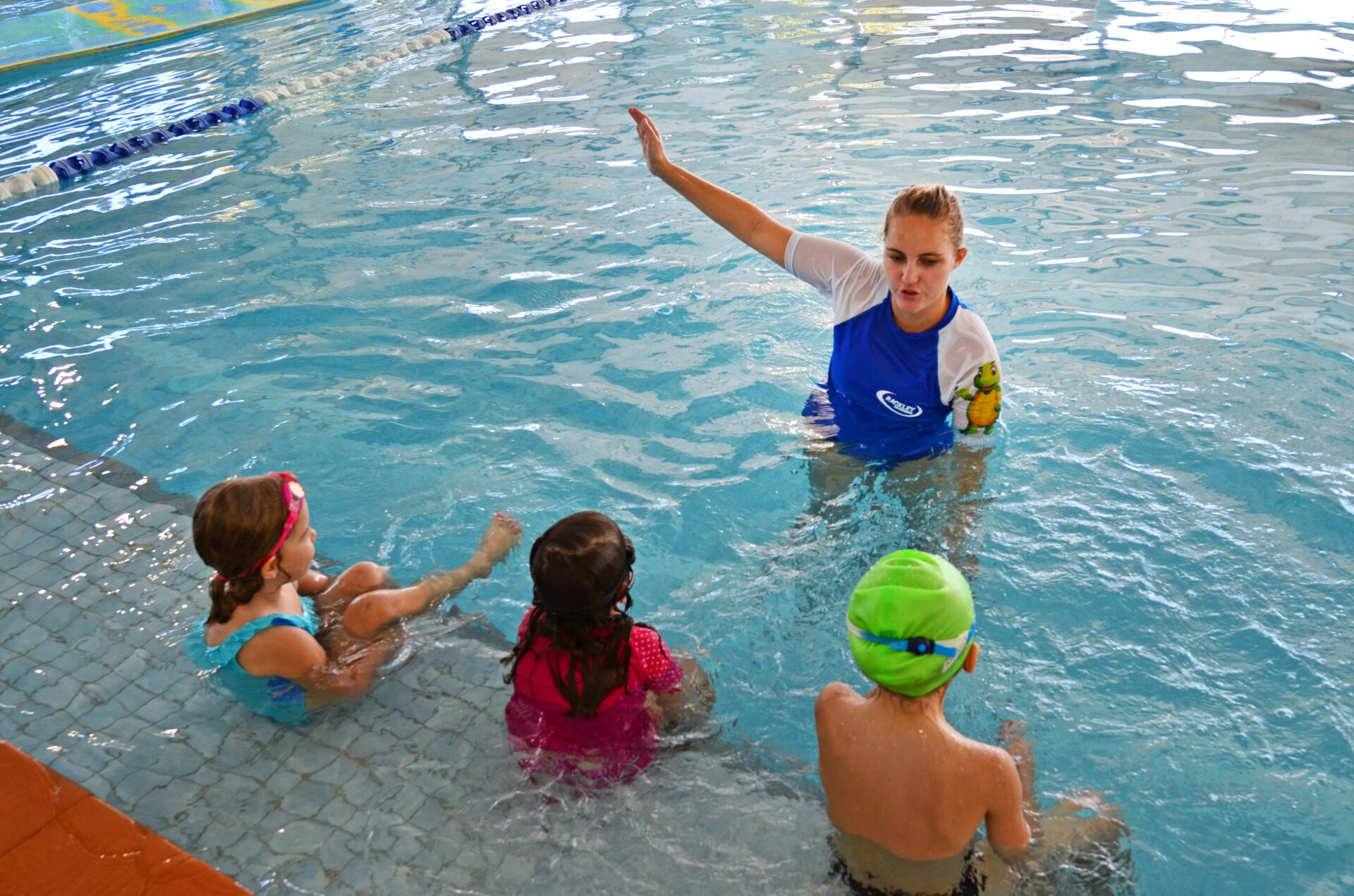
The Superpower of Intentional Swimming
As coaches, our overall goal is excellence. We aim for perfection in every stroke, hoping to create a culture where great swimming is the standard, not the exception. There is a famous adage often attributed to Aristotle that guides our philosophy here:“Excellence is not an act, but a habit.”
If excellence is a habit, then our job as instructors is to design an environment where that habit can flourish. We need a system that makes excellence the path of least resistance.
The secret to unlocking this potential isn’t finding better athletes; it’s using a better framework. It’s about harnessing the “Superpower of Deliberate Practice.” By applying the Pareto Principle—the idea that 80% of our results come from 20% of our efforts—we can transform a standard swim lesson into a high-velocity learning environment.
The goal is simple: provide as many opportunities fordeliberate practiceas possible.
The Hidden Barrier: The Logistics of Feedback
In many swim programs, the biggest barrier to student success isn’t the instructor’s knowledge; it is the logistics of the lane.
We often see lessons structured around long distances or simple aerobic sets. The intention is good—we want them to swim—but the outcome often misses the mark. When a swimmer is asked to swim a full 25 or 50 yards before they have mastered the mechanics, two things happen:
This leads tomindless swimming. It’s not that the swimmers aren’t trying; it’s that the structure forces them into “survival mode” rather than “learning mode.” When we prioritize distance over precision, we inadvertently allow swimmers to practice struggling rather than practicing excellence.
Unlocking the Superpower
The superpower of a truly effective swim program lies inavoiding mindless swimming.
We do this by changing the logistics. Instead of long lines and long waits, we utilize theRotation Methodandcircle swimming short distances.
When we shorten the distance to under 8 seconds of activity, we change the game completely. We remove the aerobic stress that causes form to break down. We keep the swimmer close enough to hear immediate feedback. Most importantly, we maximize the number of attempts.
Think about the math: In a traditional structure, a student might swim four lengths of the pool and get feedback four times. In a short-burst Rotation Method, that same student might perform a specific skill 30 to 50 times in the same timeframe.
That is the superpower.
By refining the framework of our practices into these specific chunks, we exploit attentive improvement. We design the lesson so that “good technique” is the only option. We utilize theActivity, Activity, Challenge (AAC)formula not just to keep them busy, but to keep them engaged, focused, and constantly improving.
Avoiding mindless swimming isn’t just about stopping bad habits; it’s about accelerating the good ones. It is the strategic advantage that turns a good swim lesson into a great one.
Defining Deliberate Practice in Aquatics
To fix the crisis of mindless swimming, we must first define the solution.Deliberate Practicein aquatics is not just “swimming laps” or keeping the water moving. It is a special type of practice that is specific, systematic, and characterized by a hyper-focused attention to improvement.
As discussed in<a target="_blank" rel="noreferrer noopener" href="https://www.swimminglessonsideas.com/blog/sip-085-finding-deliberate-practice-opportunities-at-swim-lessons-and-practices/">SIP 085: Finding Deliberate Practice Opportunities</a>, regular practice often devolves into mindless repetition. In contrast, Deliberate Practice requires the swimmer to internally verbalize a specific goal:“I am doing this specifically to improve my stroke in this exact way.”
The Mental Game: Swimming as Meditation
This mental engagement is the key differentiation. We know that thought leads to action; effective coaching is simply using words to compel specific physical motions. In this sense, high-level swim training shares a surprising commonality withmeditation.
Meditation is the practice of training your thoughts to do what youwantthem to do, rather than letting your “monkey mind” wander. Deliberate Practice applies this same discipline to the body. We are asking swimmers to override their natural, survival-based instincts (like lifting the head to breathe) and instead force their bodies to execute unnatural, technical movements with precision.
The Vehicle: Activity, Activity, Challenge
You cannot achieve Deliberate Practice without a rigid structure. If you tell a child to “swim freestyle,” they will revert to their lowest common denominator of movement. You must provide a framework that restricts their options toonlythe correct movement.
This is why we rely on the<a target="_blank" rel="noreferrer noopener" href="https://www.swimminglessonsideas.com/blog/sip-071-activity-activity-challenge/">Activity, Activity, Challenge (AAC)</a>framework. This formula isn’t just a lesson plan; it is a psychological tool.
By structuring the lesson this way, we ensure the swimmer is mentally present for the specific skill we are targeting, rather than just surviving the yardage.
Excellence in the Mundane
Deliberate Practice is most visible not in the complex strokes, but in the simple ones. It requires a<a target="_blank" rel="noreferrer noopener" href="https://www.swimminglessonsideas.com/swimming-ideas-podcast/">Consistent Dedication to the Mundane</a>(referencing SIP 102).
Take the streamline, for example. In a “mindless” program, a streamline is just how you push off the wall. In a Deliberate Practice program, the streamline is a habit of excellence. We teach that tonotdo a streamline should make the swimmer feel physically uncomfortable. We aren’t just practicing the push-off; we are practicing the discipline of the “lock, squeeze, look” checklist every single time.
The Instructor’s Role: Demanding Engagement
Finally, Deliberate Practice cannot happen in a vacuum. It requires an instructor who is actively breaking the “fourth wall” of the pool deck. As detailed in<a target="_blank" rel="noreferrer noopener" href="https://www.swimminglessonsideas.com/blog/one-thing-to-improve-your-swim-instruction/">One Thing to Improve Your Swim Instruction</a>, engagement is the lifeblood of this method.
If the instructor is passive, the swimmer becomes passive. To facilitate Deliberate Practice, the instructor must provide immediate, targeted feedback that forces the swimmer to think about their next attempt. We are looking for perfection, but to get there, we must create an environment that encourages—and expects—spectacular failure.
The Engine of Progress: Why Short Bursts Dominate Long Laps
Short bursts of focused swimming—under 8 seconds—allow for more repetitions, immediate feedback, and sustained mental engagement. This approach turns every lesson into a high-velocity learning environment, accelerating skill development and building habits of excellence.
The 8-Second Rule: Battling Fatigue
Why restrict a swimmer to such a short window? Becausefatigue is the enemy of motor learning.
When we ask a swimmer to perform a new skill for 25 yards, the first 5 yards might look okay. But by yard 15, the brain is no longer focused on the angle of the hand entry; it is focused on survival. The moment a swimmer gets tired, their brain switches from “Learning Mode” to “Survival Mode.”
By limiting an attempt to 5–10 seconds, we achieve several critical outcomes:
The Feedback Loop Advantage
Short bursts also give the instructor a logistical “superpower”:Immediate Intervention.
In a traditional long-lap scenario, you are stuck waiting for the swimmer to finish the distance before you can offer a correction. By the time they touch the wall, they have practiced the mistake 20 times. The “teachable moment” is cold.
In a short burst—like a “Streamline + 3 Strokes” drill—you are right there. You can stop the bad habit the second it happens. You can fix the hand entry before they even take a second stroke.
We restrict longer swims because we want the swimmer to expend their total energy on abrief, powerful burst of correct technique. Even for capable swimmers whocanswim the distance, we should avoid the temptation of the long swim when teaching a new skill.
We aren’t training endurance here; we are training the nervous system.
The Core Habit: Consistency and the Streamline Mandate
If short bursts are the engine of our program, theStreamlineis the chassis.
In the world of<a target="_blank" rel="noreferrer noopener" href="https://www.swimminglessonsideas.com">Swimming Lessons Ideas</a>, the streamline is not just a body position; it is a religion. It is the single most important element of swimming, essential for minimizing drag and maximizing speed across all strokes. Yet, it is often the first thing to degrade when a swimmer gets tired or distracted.
To harness the power of Deliberate Practice, we must view the streamline (SL) as anon-negotiable habit.
Dedication to the Mundane
We often talk about the“Dedication to the Mundane.”This is the idea that consistent, relentless focus on the simplest skills establishes the discipline required for the complex ones.
If a swimmer cannot be disciplined enough to lock their hands and squeeze their ears every time they push off the wall, they will not have the discipline to execute a complex high-elbow catch in Freestyle. The dedication to the mundane establishes the habit—for both the coach and the swimmer—thatdetails matter.
The goal is psychological as much as it is physical. We want the swimmer to have such an ingrained excellence habit that they feelphysically uncomfortableif they push off the wall without a streamline.
The Three Non-Negotiables
To teach this, we strip the streamline down to three essential components. These are the commands that should echo across every pool deck:
These three cues cover the hydrodynamics (reducing drag) and the body alignment (lifting the hips). They must be executed perfectly. Every. Single. Time.
The “SL +” Formula
This is why you will see “SL” as a mandatory prefix in almost all our short-distance activity notations (e.g.,3x SL + [Something]).
We include the streamline as part of these short bursts because it acts as a “trigger” for the brain. It signals the start of a focused attempt. By making it the initial action foreverythingwe do, we maximize the repetitions. If a swimmer does 30 short bursts in a lesson, they have practiced their streamline 30 times.
If we allow a swimmer to push off lazily, we are silently communicating that “average” is acceptable. But when we enforce theStreamline Mandate, we are teaching them that excellence is the only option.
Structure for Success: The Activity, Activity, Challenge (AAC) Framework
Deliberate Practice requires more than just good intentions; it requires a rigid architecture to hold it together. That architecture is the<a target="_blank" rel="noreferrer noopener" href="https://www.swimminglessonsideas.com/blog/sip-071-activity-activity-challenge/">Activity, Activity, Challenge (AAC)</a>framework.
This framework is one of the<a target="_blank" rel="noreferrer noopener" href="https://www.swimminglessonsideas.com/blog/the-three-pillars-of-effective-teaching-for-swimming-instructors/">Three Pillars of Effective Teaching</a>in our philosophy. It is a formula designed to balance intense cognitive load with energetic release, ensuring that our “short bursts” of swimming remain high-quality throughout the entire lesson.
The Three-Part Learning Cycle
The AAC formula works because it mimics the natural way the brain learns new motor skills:Establish, Expand, Reset.
1. Activity 1: The Foundation
This is your baseline. Activity 1 is the “anchor” skill upon which everything else will be built.
- In this stage, the focus is singular. We are establishing the non-negotiable standard (e.g., “Lock, Squeeze, Look”). This is where we demand the highest level of perfection because the complexity is low.
2. Activity 2: The Fine Point
Here, we layer complexity on top of the foundation. Activity 2 is always connected to Activity 1.
- This is the “Fine Point.” The swimmer must now execute a new skill (the strokes) whilestill being accountablefor the foundation (the streamline).
3. The Challenge: The Palate Cleanser
After two rounds of intense, deliberate focus, the brain needs a break. If we push for a third round of high-focus technical work, the quality will drop.
- The “Challenge” is designed to be apalate cleanser. It is a quick, energetic, and fun diversion.
- While it often still reinforces swimming skills, the primary goal here is to reset the brain. It injects energy back into the class and clears the mental slate, so the swimmers are ready to focus again when we loop back to a new Activity 1.
Why It Works
TheActivity, Activity, Challengeformula prevents the “zombie mode” seen in traditional swim lessons. By constantly shifting between foundational focus, complex application, and energetic play, we keep the swimmers on their toes. We aren’t just filling 30 minutes of time; we are engineering a rhythm of learning that maximizes engagement.
Implementation: The 3x SL + [Something] Rotation Method
Now that we have the framework, how do we actually move the bodies in the water? The implementation relies on a specific formula:3x SL + [Something].
As we discuss in<a target="_blank" rel="noreferrer noopener" href="https://www.swimminglessonsideas.com/swimming-ideas-podcast/">SIP 101: Routine for Developmental Swimming</a>, this format is the “scaffolding” of our most effective teaching moments. The structure remains constant, allowing the instructor to swap in any number of skills for the “[Something]” component without confusing the class.
The Rotation Method: Circle Swimming in Miniature
To make this work without chaos, we use theRotation Method. This is essentially<a target="_blank" rel="noreferrer noopener" href="https://www.swimminglessonsideas.com/blog/swim-teams-teaching-circle-swimming/">Circle Swimming</a>condensed into a 5-yard box.
We deliberately keep distances short (no more than halfway across the pool). Here is how the flow works:
- Swimmers line up on the wall.
- Swimmer 1 performs the activity (e.g., SL to the flags) and stops.
- They move directly across the lane (ducking under the lane line if necessary or just scooting over).
- They swim/walk back to the starting wall on the opposite side of the lane.
- They return to the back of the line.
This creates a perpetual motion machine. A group of four swimmers can complete this sequence three times in under three minutes once they know the setup.
The “No-Go” Rule
The secret to the speed of the Rotation Method is the removal of dead air.
As detailed in our<a target="_blank" rel="noreferrer noopener" href="https://www.swimminglessonsideas.com/blog/training-module-command-language/">Command Language Training Module</a>, an instructor should avoid wasting time and breath telling swimmers when to “Go.”
In this format, “Go” is implied. As soon as the person in front of you leaves, you go. The instructor’s voice should be reserved exclusively forfeedback, not traffic control. By removing the “Ready, Go!” from the loop, we reclaim minutes of practice time that used to be lost to silence.
The Accelerant: Immediate and Targeted Feedback
The Rotation Method and Short Bursts create the logistical opportunity, butfeedbackis the accelerant. It is the product we are actually selling. If parents just wanted their kids to get wet and tired, they could buy a pool pass. They pay for lessons because they wantcorrection.
As we outline in<a target="_blank" rel="noreferrer noopener" href="https://www.swimminglessonsideas.com/blog/the-three-pillars-of-effective-teaching-for-swimming-instructors/">The 3 Pillars of Effective Teaching</a>, without feedback, you aren’t teaching; you are just supervising recess.
Silence is Approval
The most dangerous sound on a pool deck is silence.
When an instructor watches a swimmer perform a skill incorrectly and says nothing, they have just communicated a powerful message:“That was perfect.”
Silence validates the error. If a swimmer performs a streamline with their head up and you simply wave the next kid to go, you have effectively taught the first swimmer that looking forward is the correct technique. In our system, the instructor must be an active barrier to bad habits. You must intervene.
The “Good Job” Trap (and How to Escape It)
The biggest enemy of effective feedback is the reflex to say “Good Job.”
As we argue in<a target="_blank" rel="noreferrer noopener" href="https://www.google.com/search?q=https://www.swimminglessonsideas.com/blog/5-things-to-say-instead-of-good-job/">5 Things to Say Instead of “Good Job”</a>, general praise is not just lazy; it is useless. If a swimmer performs a sloppy streamline and you say, “Great job!”, you have just lowered the bar for the entire class.
Feedback must beTargeted and Specific. It must link an observable behavior to a specific skill. To escape the “Good Job” trap, use this formula:
The “One Thing” Rule
Because we are using short bursts, we have a limited window for communication. Do not give a dissertation. A drowning swimmer cannot process a paragraph of information.
We adhere to the<a target="_blank" rel="noreferrer noopener" href="https://www.swimminglessonsideas.com/blog/one-thing-to-improve-your-swim-instruction/">One Thing Rule</a>. Even if a swimmer makes five mistakes, pick theonemistake that is most critical to their safety or foundation (usually body position or breath control) and fix that.
If you throw five corrections at a child, they will catch none of them. If you throw one, they will catch it. And because of theRotation Method, they will have another attempt in 15 seconds to fix the next error.
Kinesthetic Feedback: Moving the Body
Words often fail in the water. The aquatic environment is loud, and young children often lack the proprioception (body awareness) to know what “straight legs” feels like.
Don’t just talk;manipulate.
Effective instructors are hands-on. If a swimmer’s head is too high, gently press it down into the water (with permission/warning) so theyfeelthe correct buoyancy. If their arms are wide, squeeze them into a streamline. As discussed in our<a target="_blank" rel="noreferrer noopener" href="https://www.google.com/search?q=https://www.swimminglessonsideas.com/blog/training-module-manipulation/">Training Module: Manipulating the Body</a>, muscle memory is built faster when the muscles are physically guided into the correct path.
The Permission to Be Blunt
Finally, because we are operating in a high-repetition environment, we have permission to be direct. We don’t need to “sandwich” every correction between two compliments.
If a swimmer fails spectacularly, it is acceptable—even necessary—to be objective. You can say,“Your legs sank because you looked forward. Look down next time.”
Coaching Language and Demanding Excellence
We have established the structure and the feedback, but the delivery mechanism is just as critical. The specific words and tone you use can either command attention or invite chaos.
In theSwimming Lessons Ideasmethodology, we rely on<a target="_blank" rel="noreferrer noopener" href="https://www.google.com/search?q=https://www.swimminglessonsideas.com/blog/teaching-swimming-using-command-language/">Command Language</a>.
The Period vs. The Question Mark
The most common mistake new instructors make is speaking in question marks. They soften their instructions because they want to be liked. They say things like:
This is the“Dangling Okay.”It is a verbal tic that destroys authority. When you add “, okay?” to the end of a sentence, you are grammatically turning a command into a request for permission. You are asking a 6-year-old if theyagreewith your lesson plan.
To maximize focus in short bursts, you must speak inperiods.
This isn’t being “mean”; it is being clear. Teaching swimming is the art of using words to make other people’s bodies move. If your signal is fuzzy, the movement will be fuzzy. Concise, confident commands cut through the noise of the pool deck.
The Standard is Excellence
Because we have removed the fatigue factor by using short bursts (Section III), we have removed the valid excuses for poor technique.
If a swimmer is at the end of a 200-yard IM, we might forgive a low elbow. But if they are only swimming for 5 seconds?We demand perfection.
As discussed in<a target="_blank" rel="noreferrer noopener" href="https://www.swimminglessonsideas.com/swimming-ideas-podcast/">SIP 064: Expecting Perfection</a>, you get what you accept. If you allow a swimmer to perform a sloppy streamline during a warm-up drill, you have just set the standard for the day. You have communicated that “mediocre” is the goal.
Non-Enforcement is Endorsement
This brings us to the golden rule of high-focus coaching:Non-enforcement is endorsement.
If you see a mistake and you do not correct it, you are endorsing it. If you tell a class “Streamline off the wall,” and Johnny pushes off with his hands at his sides, and you say nothing? You have just taught Johnny—and everyone watching him—that the streamline is optional.
In our<a target="_blank" rel="noreferrer noopener" href="https://www.swimminglessonsideas.com/blog/sip-071-activity-activity-challenge/">Activity, Activity, Challenge</a>framework, the instructor must be relentless. Because the attempts are short and the rotation is fast, you have the energy to enforce every single rep.
Do not let the “little things” slide. In swimming, the little things (thumb lock, head position, tight core) are theonlythings.
Conclusion: The Long-Term Impact of Short, Focused Work
Ultimately, the success of a swim program isn’t measured by how tired the kids are at the end of practice; it is measured by the habits they carry with them for the rest of their lives.
As instructors and program directors, we are the leaders. It is our responsibility to establish the routines and the vision that make excellence the default setting. By moving away from the “crisis of mindless swimming” and embracing theActivity, Activity, Challengeframework, we are doing more than just teaching strokes. We are teaching the discipline of mastery.
The long-term impact of this shift is profound. When you utilize theRotation MethodandShort Bursts, you are giving a swimmer 30 to 50 opportunities to execute a perfect streamline in a single lesson. Compare that to a traditional lap-swimming format where they might only push off the wall 10 times (and do it incorrectly half the time).
Over the course of a session, that difference in volume—volume of perfection, not just volume of yardage—compounds.
We are building a feedback loop where the swimmer learns to crave the feeling of efficiency. We are mixing the “classical conditioning” of strict technique work with the joy of the “Challenge” games. The result is a swimmer who not only looks better in the water butlovesthe process of getting better.
Excellence is a habit. It’s time to design our lessons to support it.
Tomorrow we can teach better lessons together.
Discussion0 comments