
Why Body Line Matters
The last few weeks I've been teaching a parent-tot class while training new staff. It's giving me some insight into why we do the things we do.
Why are we spending so much time on body position and how to hold the child? During swim lessons, why do we devote the majority of the lesson time to glides and streamlines? We spend almost 70% of a lesson on body position and finding the "line."
Over the weekend I went to a swim meet to help with our age group coach. I spent the mornings watching elite swimmers who had come through our developmental program (many from swim lessons), and remembered how important body position and spinal line is for swimming.
We devote the majority of our swim lesson time to body line and positioning because it is the first, fundamental skill that swimmers need to do any of the strokes well.
While "going underwater" might be the bulk of our instruction to beginners within the 0–5-year-old ages, after they've grown comfortable submerging we do glides, glides, and more glides. We demand an ever-flowing torrent of glides and streamlines to bake into the cake for their swimming a long body line that holds a lengthened position during their movement.
I'm reminded of Richard Quick's "Posture Line and Balance" book where he details through images and drills the best way to achieve champion success in competitive swimming.
Teaching Body Line to Beginners
Teaching the parent-tot class on weekends reiterated how important body line is even for infants. For those families and parents who are more comfortable in the water, they already naturally keep their shoulders and hips level with their babies. It's important to flatten the baby's body so that it can more naturally feel what it's like to glide through the water in a streamlined position.
As we move through our Level 1, which is focused on going underwater, we utilize the same handholds for front floats and back floats designed to support the child's body without damaging their ability to get into a good body line on their own.
Even as we continue to Level 2 and Level 3, the bulk of our swim lesson time is focused on streamlines from bench to bench, or streamlined followed by swimming.
Utilizing short distance training combined with endurance distance like kicking in 25-yard sets with fins, we're giving our swimmers an opportunity to build a habit of a long, narrow body emphasizing the "line."
From freestyle to backstroke, butterfly to breaststroke, we always aim for that long body line stretched out in position 11.
Drills and Activities for Body Line
All of our swimlesson plansand skill sheets aim at the singular concept: through good body posture, find the line. We know that by doing that, our swimmers will succeed and more easily be able to move through the water manipulating their arms through any of the four competitive strokes.
For Swimming Ideas, finding the line and maintaining good body posture is crucial for the success of our participants.
Dryland – Partner Posture Walk

Dryland – Partner Posture Walk
Create small groups.
- One person sits on the floor with great back posture and legs crossed.
- Partner puts a finger on their head, and walking with excellent posture moves around the person on the floor two times.
- Switch. Increase speed or make the walker do more challenging things like streamline or position 11.
Partner Pull Position 11

Partner Pull Position 11
One person bends at the waist and the knees, extending arms forward. Partner grabs wrists and pulls forward slightly, while lifting to horizontal. Goal is to get back flat and arms flat like doing a standing position 11.
Challenge: 20 Flutter Kicks in Position 11
Challenge: With two hands on the horizontal line of the + (mark on the wall), do 20 flutter kicks staying underwater in position 11.
3x Streamline + Position 11 for 5 Kicks + 1 Freestyle Stroke

3x Streamline + Position 11 for 5 Kicks + 1 Freestyle Stroke
Streamline with freestyle kick. At the surface, transition from streamline to position 11. Continue kicking for 5 kicks in position 11. Continue kicking and do one arm stroke of freestyle. Leave the other arm in position 11 place.
How do you incorporate "the line" into your lessons? Comments in the space below.
Dryland – Start into Streamline
On deck have everyone squat to the floor. Do 3 – 5 times. Tiring.
Keep the back as straight as possible.
Put their hands on their head like the picture.
Stand into streamline.
“Grow from a tiny sprout into a tall reaching streamline.”
Locked thumb Squeezed ears Face straight ahead (looking down)
The goal here is to establish a habit of going from hands on the head to streamline immediately and teach how it feels to push off the wall in streamline.
Streamline from Above
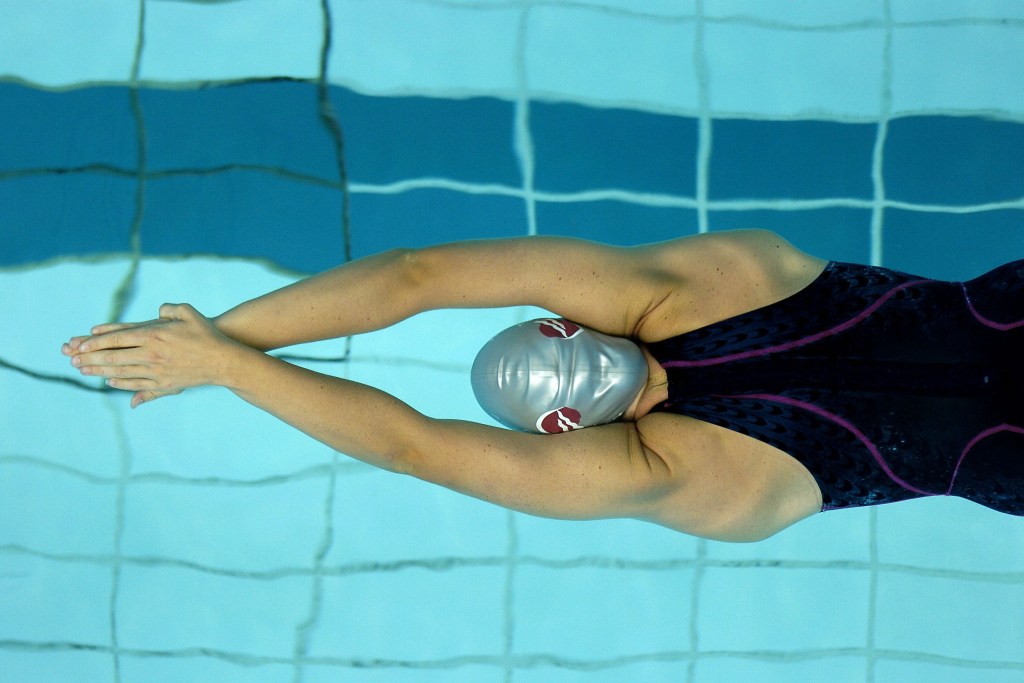
What are the 3 things for streamline we’re working on?
1) Lock Thumb 2) Look Down 3) Squeeze Ears with elbows
Standing on Deck, demonstrate and say it.
Dryland – Start into Streamline
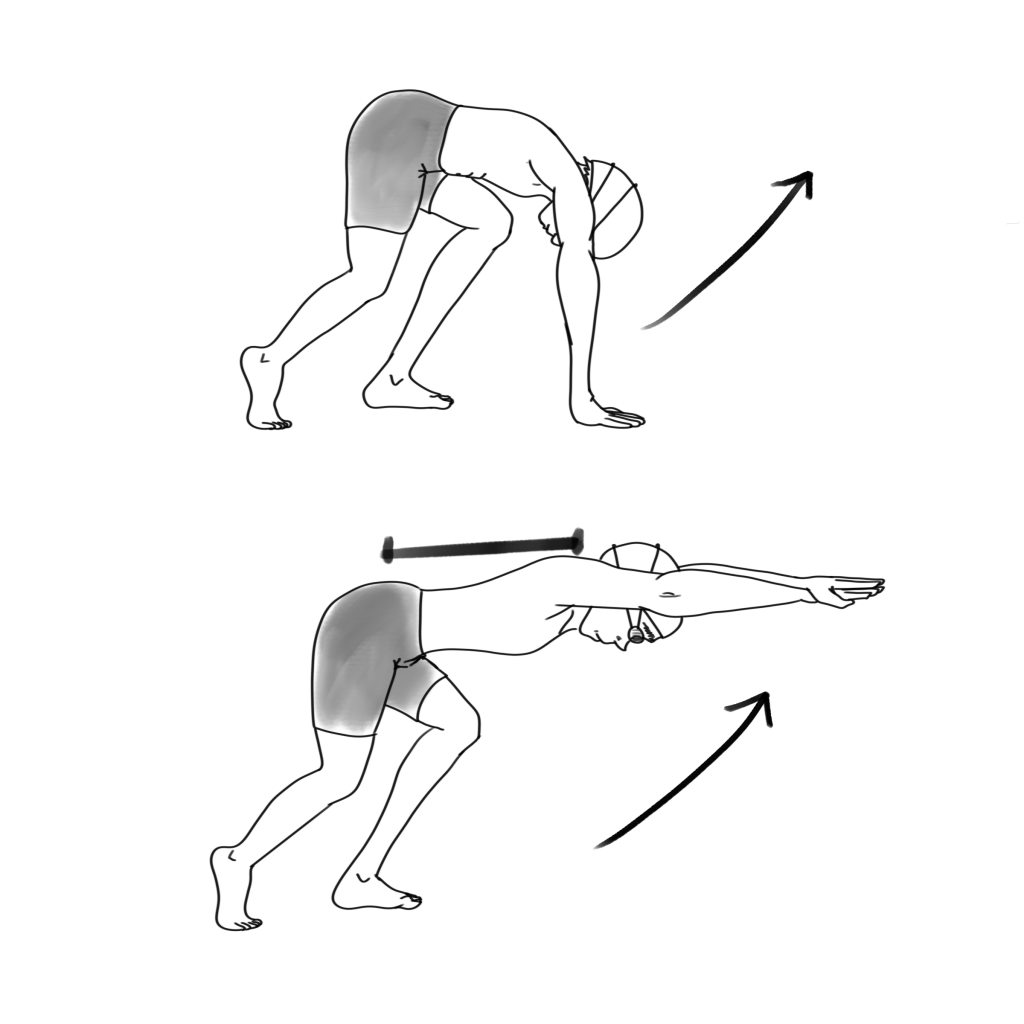
Dryland – Start into Streamline
Dryland Start Practice (No Blocks Needed)
This is a great activity to practice a start without having a block or deep enough water.
Begin folded over your hips with feet aligned like doing a start on the blocks or the edge of the pool.
Coach says, “Take your mark, Go!”
When the swimmer hears “Go,” then they lift their hands quickly into streamline attempting to keep their back flat, and their head squeezed by both arms.
BONUS with Partners
BONUS with partners:
Have one person stand in front of the starting person’s head. When the coach or someone says “go,” then hold their hand above where you think the hands should reach, low enough to keep the back flat.
Partner holds their hand above the same level as the top of the person doing the “start’s” hips.
The swimmer doing the start keeps head low and hits their partner’s hands in streamline as fast as they can.
Dryland – Streamline Roll
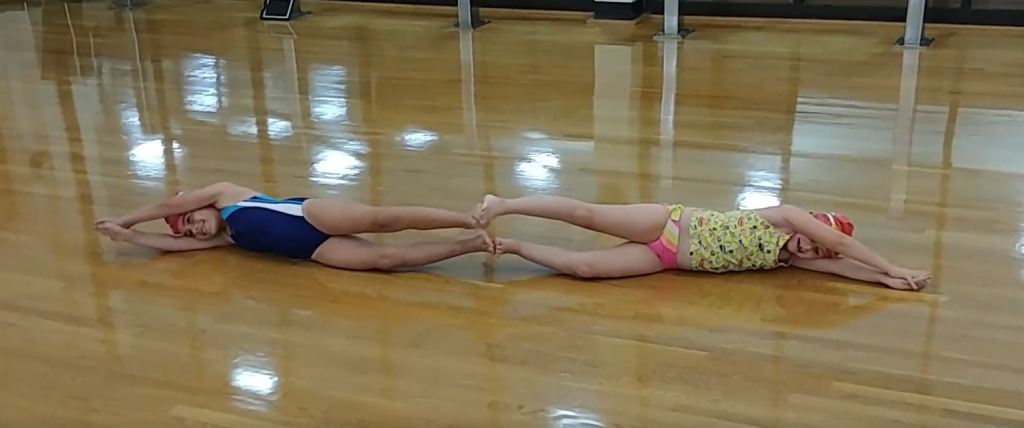
Dryland – Streamline Roll
Find a partner. Lay on your backs foot to foot. Heads away from each other. Get in Streamline position. Roll together in the same direction for 1 full roll, or 2. Feet must remain connected, and bodies should roll together to earn a “success.”
Fail when feet fall apart, streamlines fall out, or when one body turns but the other doesn’t.
Discussion0 comments