
The most popular swim lesson program is the American Red Cross Learn-to-Swim. I grew up teaching them, and was even certified as a Water Safety Instructor, ARC‛s version for advanced swim instructor training. I remember feeling so official, so empowered and enthusiastic about finally being able to "sign the cards." And then I filled out a 25 forms in a day for my five classes. I remember checking off all the boxes because they were redundant and barely paying attention to the actual words and skills (I was in high school, and boring stuff sucked: I wanted to find the quickest way to do things).
Swim lessons are tedious sometimes. They require significant assessment of your swimmers to gauge their progress and improvement. You can use the information that you track to determine the effectiveness of your swim instructors and identify key areas of improvement. If you have a successful program, it means filling out evaluation forms for hundreds of people every session.
Do you like filling out 500 evaluations every two weeks? What about having your managers do it, or worse, having the swim instructors doing it themselves? How many hours does it take to proof read them all? If you‛t doing it yourself, are you paying managers to do it each week? There is a better way.
Before we get into that better option for filling out evaluations, let‛s look first at the actual evaluations themselves. Here is a question for you:
<strong>How many skills do you test in each level?</strong>
American Red Cross Learn to Swim is one of the most popular swim lesson programs in America. When I do phone interviews with swim managers, they almost unanimously say how they‛re unhappy with ARC and have modified it in some way. Take a look at the Level 1 skills for their learn to swim program, which is for swimmers age 6+ all the way up to adults.
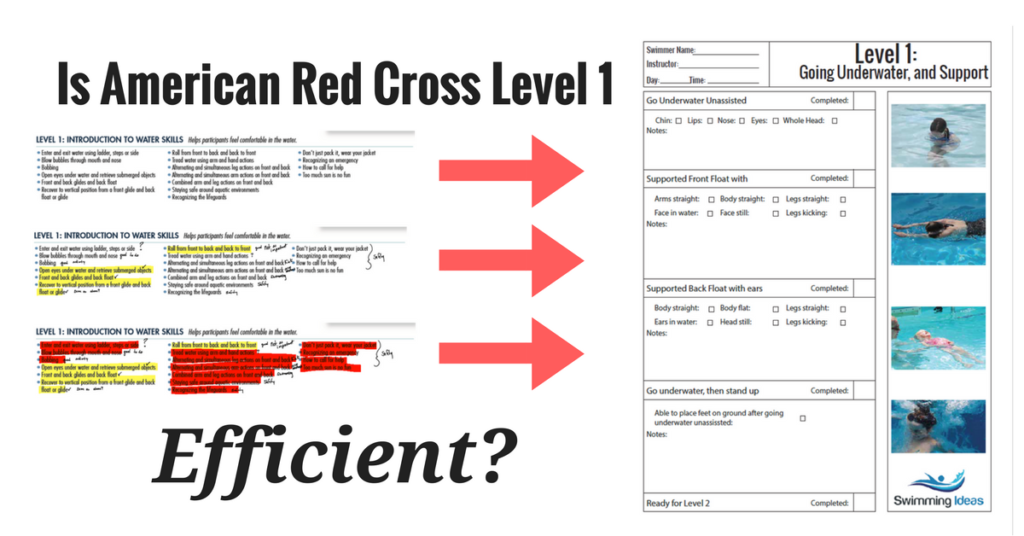
Here is ARC‛s level 1 skill sheet right now:
You can count them, but trust me when I say there are 17 skills there for Level 1. 17 skills. Let that sit in for a second. Seventeen skills for the "introduction to water skills class." The intro. The beginning, the start. The most basic place to begin has 17 different skills required before moving on to the next level "Fundamental Aquatic Skills."
That is way too many skills for a starting class.
Do you think that 17 skills for your Level 1, first class a participant joins should have 17 skills? Do you think it is efficient?
I think you know. Having 17 skills as your intro class is definitely not efficient. I emphatically believe that we should reduce the number of <strong>testable</strong> skills to the fewest number possible. Swimming Ideas level 1 has 4 skills. Four skills to test for each swimmer. It makes assessment easy, quick, and efficient.
Level 1: Swimming Ideas Approach
Going Underwater, and Support
- Go underwater unassistedSupported front float with face in waterSupported back float with ears in waterGo underwater, then recover to standing on own
There are four skills here that we test for Swimming Ideas level 1. Four things that are the most significant and important things for beginning swimmers to focus on. I‛ve highlighted the items closest withing ARC Level 1 that matches Swimming Ideas‛.
If the picture doesn‛t seem clear, there are four things highlighted here:
- Open eyes underwater and retrieve submerged objectsFront and back glides and back floatRecover to vertical position from a front glide and back float or glideRoll from front to back and back to front
These are the distilled, most refined, and basic skills that truly define ARC‛s Level 1. Essentially they are go underwater, float, glide then stand up. You‛ll notice how similar they are to Swimming Ideas‛ level 1. Before we move on, let me ask another question: "What do you do when you have to quickly test 30 8 year olds?"
Streamlining Assessment for Large Groups
I bet you‛t say "I test each one on all 17 skills." No, of course you‛t. You probably said, "I see if they go underwater and can move their arms in some fashion to move themselves forward." Out of necessity, out of ease of use, you have distilled down to the most basic core skills of the level. The chances are, if a swimmer can go underwater easily, they can likely float. If they can float, they can probably glide, and if they‛re comfortable on their back, they can roll over onto the front easily. So when you have those 30 kids and 10 minutes to test them, you drill down to the heart and ask, "Who goes underwater, and of those, who can do a front glide into a back float?"
Let‛s look at that ARC Level 1 list again, and highlight the skills that you should not be testing:
Once again, I‛ll list out those items that are in red to make it easier to read:
- Enter and exit water using ladder, steps, or sideBlow bubbles through mouth and noseBobbingTread water using arm and hand actionsAlternating and simultaneous leg actions on front and backalternating and simultaneous arm actions on front and backCombined arm and leg actions on front and backRecognizing the lifeguardsDon‛t just pack it, wear your jacketrecognizing an emergencyHow to call for helpToo much sun is no fun
Why Remove the Basic Skills from Testing?
Have you ever asked a swimmer to show you how to get in and then out of the water using the ladder, steps, or side of the pool? How did you even start your lesson if they‛t get it? How did they leave every day. That is an easy one to remove from your test, from your evaluation, because it‛t a necessary testable skill. It is only a thing to do, and yes, a good idea to teach, but it takes about 30 seconds of time to demonstrate and do.
Discussion0 comments